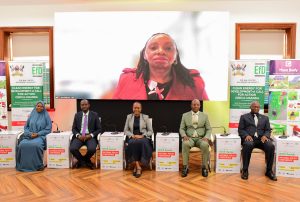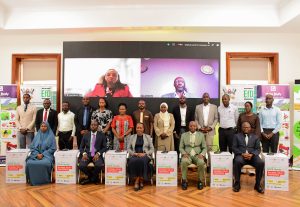
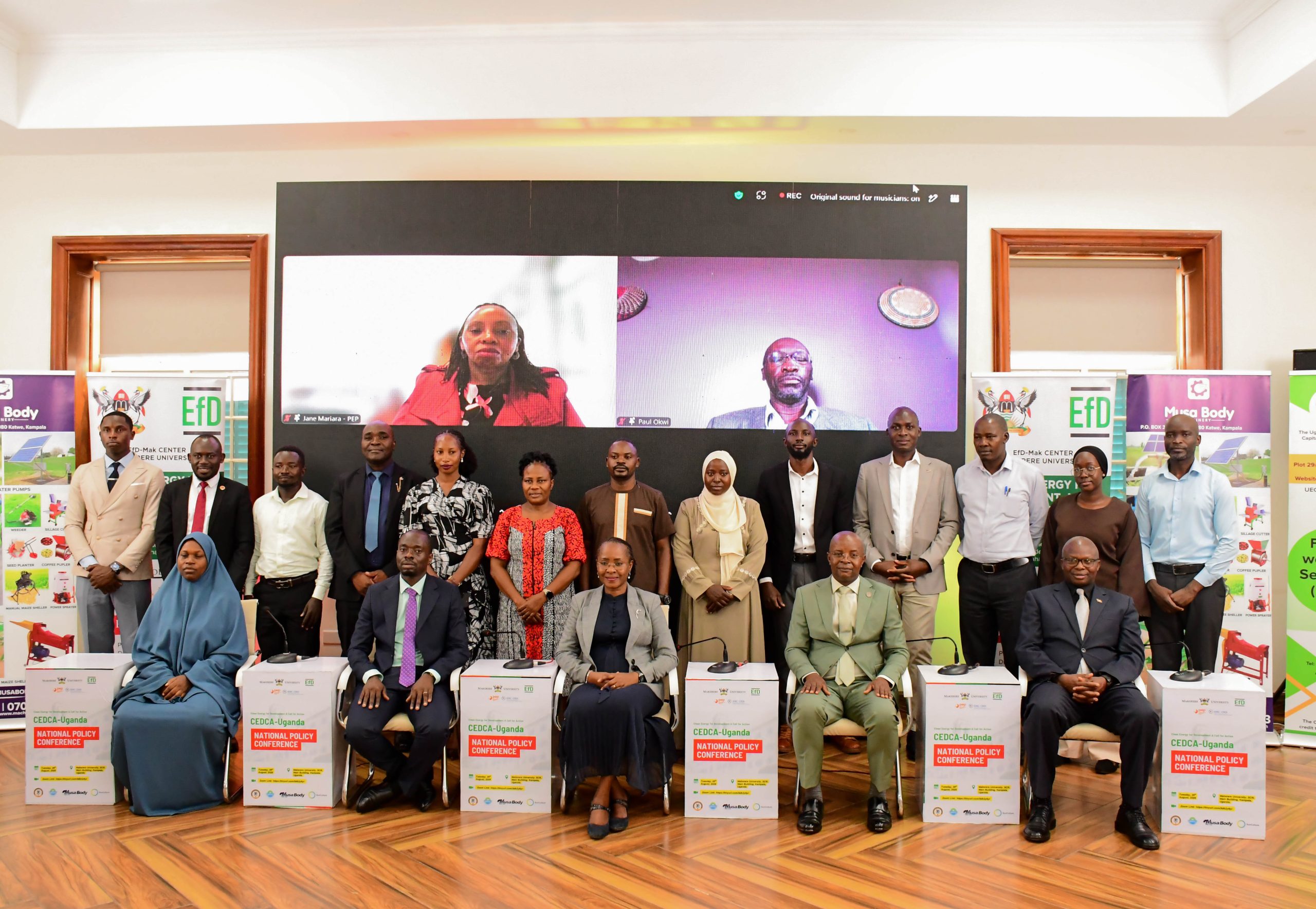
August 25, 2026: Makerere University, in collaboration with the Environment for Development (EfD), the College of Business and Management Sciences (CoBAMS), the Partnership for Economic Policy (PEP) and the International Development Research Centre (IDRC-CRDI), on Tuesday 25th August 2026 hosted the Clean Energy for Development: A call for Action (CEDCA-Uganda) National Policy Conference 2026.
The CEDCA research project is aimed at contributing to the realization of a sustainable energy transition and agricultural transformation. Through this research project, the Makerere University research team led by Prof. Edward Bbaale, is committed to building an economy that is resilient, inclusive and climate sensitive. The CEDCA research project positions Makerere University to significantly champion the mitigation of the effects of climate change through clean energy technologies, evidence-based research, engagement of small holder farmers, policy makers, government and the private sector. The Uganda Energy Credit Capitalization Company (UECCC), Musa Body Machinery Ltd, and the Sun Culture are key partners on the CEDCA project.
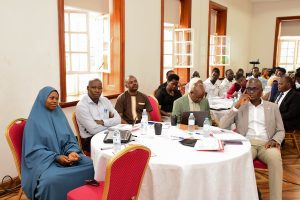
Convened under the theme “Rural Renewable Energy MSMEs Operating to Modernize Agriculture in Uganda: Barriers, Opportunities, and Implications for Inclusive Low-Carbon Transition, the hybrid National Policy Conference, which focused on the dissemination of findings that impact the Agriculture sector, attracted notable participants including government officials, researchers, planners, policy makers, economists, farmers, community leaders, machine fabricators, specialists in agriculture, youths, academicians, students, engineers and the media to deliberate on scaling clean energy for agricultural transformation.
During the Conference, each participant received a copy of the Policy Brief titled: “Community Service Centres Can Expand Smallholder Adoption of Low-Carbon Agricultural Technology.” The Policy Brief is a key output of the CEDCA research project.
The participants were delighted to witness the co-created hybrid Maize Sheller, a clean smart technology, which is an outcome of the collaborative effort of CEDCA research team, Musa Body Machinery Ltd, and farmers.

At the government level, the National Conference brought onboard the Ministry of Energy and Mineral Development, the Ministry of Local Government, the Ministry of Agriculture, Animal Industry and Fisheries, Ministry of Water and Environment, and the Ministry of Gender, Labour and Social Development.
Government commends CEDCA research project
“The Ministry of Energy and Mineral Development (MEMD) was pleased to collaborate on the CEDCA project from the inception. Uganda is an agricultural country employing over 70% of the population, with the majority being women and youth, contributing significantly to our national GDP. When our rural farmers and small enterprises lack access to clean energy technologies, we lose critical opportunities to enhance the agricultural yields, productivity and food security.The CEDCA Project is a timely intervention,” said Mr. Hatimu Muyanja, who represented Hon. Dr Monica Musenero Masanza, Minister of Energy and Mineral Development.
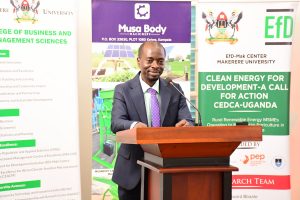
Mr. Muyanja who was assigned as a key contact for the Ministry of Energy and Mineral Development from the inception of the CEDCA research project disclosed that he has actively participated in the engagement with the private sector, farmers, and community leaders.
On behalf of the Ministry of Energy and Mineral Development, Mr. Muyanja commended the CEDCA research team for developing a policy brief that highlights the need for Community Service-Centres. Mr. Muyanja noted that the centres are crucial in building capacity at the community level with people who can assess the technology requirements and work with the farmers to come up with appropriate interventions.
In a call for action, Mr. Muyanja emphasized the importance of partnerships to bridge research and policy. “Bridging the gap between the academic research and actionable policy requires continuous collaboration. The Ministry remains committed to working with Makerere University and other partners in the promotion of Clean Energy for Development,” he stated.
Presentation of the Project findings
The conference featured a series of technical presentations, including Study Diagnosis and Design by Prof. Edward Bbaale; Intervention I: Results and Policy Implications by Dr Aisha Nanyiti; Intervention II: Results and Policy Implications by Dr Florence Lwiza; and Key Project Outputs by Mr. Gyaviira Ssewankambo
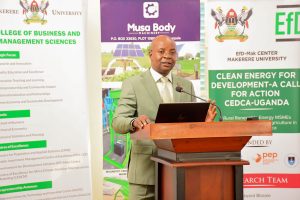
Presenting the study findings, Prof. Edward Bbaale, Principal of the College of Business and Management Sciences (CoBAMS) and Principal Investigator of the project on accelerating low-carbon agricultural technologies in Uganda, said the research was informed by climate change. He observed that Uganda is experiencing increasingly unpredictable rainfall and heat waves, noting that “rains are no longer very predictable” while temperatures continue to rise.
Prof. Bbaale emphasized that for smallholder farmers to remain productive, “irrigation and value addition is indispensable,” yet both require machinery. The project, implemented in partnership with Musa Body Machinery Ltd and SunCulture, assessed the extent to which farmers could adopt low-carbon technologies such as solar-powered irrigation as an alternative to diesel and petrol pumps.
He noted that farmers remain distant from manufacturing hubs and lack adequate information on available technologies. He stressed that “farmers are very far from where these technologies are fabricated” and that “farmers are facing affordability issues,” despite government subsidies for low-carbon equipment through the Ministry of Energy and other initiatives. Many rural farmers, he added, are not connected to the national electricity grid, making electric-powered irrigation prohibitively expensive.
Prof. Bbaale called for deliberate economic policy incentives to support local firms to manufacture and fabricate appropriate solutions, enhanced information dissemination, and mechanisms to improve affordability. Emphasizing that “we need to do something about climate change” and that “affordability is a key issue but also information flow,” he urged holistic prioritization of resources, noting that agriculture cannot be viewed in isolation from infrastructure development and agro-processing.
Low Carbon agricultural technologies are about people
Representing the Vice Chancellor of Makerere University, Prof. Barnabas Nawangwe, the Deputy Vice Chancellor (Academic Affairs), Prof. Sarah Ssali stated that the CEDCA National Policy Conference reflected the collaborative spirit that binds the academia, government, private sector, development partners, and communities in pursuit of sustainable development.
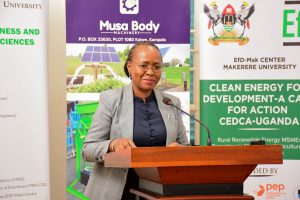
Prof. Ssali said the CEDCA study sought smart energy solutions because “our agriculture is climate-prone” and “weather patterns are no longer predictable.” She noted that the cost of equipment remains prohibitive for rural farmers and observed that the CEDCA research initiative aimed to identify “affordable and sustainable ways” of addressing climate challenges by linking fabricators such as Musa Body Machinery Ltd, researchers, farmers and policymakers to build a supportive ecosystem.
“Let us remember that the transition to low-carbon agricultural technologies are not just about machines, it is about people. It is about empowering farmers, strengthening livelihoods, and securing Uganda’s food sovereignty and climate resilience,” she said.
Prof. Ssali called upon the stakeholders and participants to work together to scale up awareness campaigns to ensure farmers know about government programmes, reduce inspection and transaction costs through community-based solutions, develop innovative financing models that make technologies affordable, ensure inclusion of women and youth in ag-tech value chains, and to strengthen partnerships between academia, government, private sector, and communities.
She thanked the farmers who participated in the study, the community leaders who supported its implementation, and the stakeholders who engaged in the co-creation workshops. “Your involvement has ensured that CEDCA research is not only academically sound, but also deeply rooted in the realities of our communities.”
Keynote Address on the Productive Use of Energy in Uganda
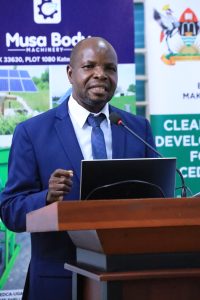
Associate Professor Fred Matovu from the School of Economics at Makerere University and a researcher under EfD delivered a powerful keynote address on the productive use of energy in Uganda.
To engage the participants, Associate Professor Matovu also tapped into his experience as a maize farmer to challenge the research team and participants to think critically on the results of the research, and what they mean to the different categories of farmers and people in general.
The Keynote Speaker tasked the researchers and panelists to think of Energy use that is productive for our people, with a focus on climate-smart and environment friendly/resilient approaches or technologies. He asserted that the technologies or interventions should be accessible, affordable, cost-effective, feasible, reliable and acceptable.
Stressing the issue of affordability, Associate Professor Matovu reflected on the global practice where farmers receive government subsidy.
“Agriculture is not profitable. That is why globally, we have government subsidies to farmers. Any government that is not going to invest to subsidize farmers-especially crop farming, is not going to transform society through farming,” he guided.
Panel Discussion on the Productive Use of Energy
A high-level panel discussion on scaling up clean energy adoption was chaired by Dr Peter Babyenda, Policy Engagement Coordinator at MakCoBAMS. The Panelists included Ms. Babirye Habeeba from Musa Body Group, Mr. Ausi Sembatya, a farmer, Dr Nicholas Kilimani, Senior Lecturer in the Department of Policy and Development Economics at MakCoBAMS, and Mr. Alfred Kizza, Risk Manager at UECCC.

The panelists stressed the need to accelerate adoption of Productive Use of Clean Energy technologies to drive Uganda’s economic transformation, noting that scaling solar-powered irrigation, cold storage and agro-processing equipment is critical for jobs, food security and rural incomes. They identified high upfront costs, limited smallholder financing and fragmented policies as major barriers and advocated for blended finance models, local assembly and manufacturing, and integrated energy-agriculture planning.
The panel-audience engagement reflected on the need to interest the youth in farming, construction of water sources in rural areas, deliberate involvement of community leaders and government ministries in research, as well as, awareness campaigns to interest farmers in government programmes.
Transition to Clean Energy is an Agricultural Challenge
On behalf of the Environment for Development Network, Prof. Martin Visser at the University of Cape Town, South Africa thanked Makerere University, CEDCA research team, policy makers, private sector, partners and participants for a very engaging and productive conference.
“The value of this conference is more than bringing people together, its real value lies in creating spaces where research evidence, policy priorities, and practical experiences come together to inform action. The Clean Energy for development agenda should be seen from this perspective,” said Prof. Visser.
She observed that Uganda’s clean energy transition is a development challenge. Given the importance of agriculture to Uganda’s economy and livelihoods, Prof. Visser stated that clean energy transition is also an agricultural challenge.
Prof. Visser noted that Clean Energy for development technologies have far reaching implications on agricultural transformation, with access to finance remaining a major barrier affecting its adoption and utilization by small holder farmers.
She said clean energy for development must go beyond electricity connections to address what enables access. She stated that “providing access to clean energy is only the beginning of this journey” and that “availability of a technology does not necessarily mean that farmers or enterprises will adopt it.”
She observed that while farmers may recognize the benefits of solar irrigation, they may lack financing, information, technical skills and reliable after-sales support. She urged that policy should equally address adoption and productive use, and called upon governments to create an enabling policy environment for clean energy for development and agricultural transformation.
Officially closing the National Policy Conference, Prof. Visser reiterated that Clean Energy becomes transformative when people can adopt it and use it productively to improve their livelihoods.
Moderated by Dr Peter Babyenda and Ms. Ritah Namisango, the National Policy conference observed that achieving an inclusive low-carbon transition in Ugandan agriculture will require coordinated action across energy, agriculture, finance and rural development policies. Participants agreed that sustainable transformation depends on affordable technologies, robust financing, local manufacturing, and a strong ecosystem of information, skills, markets and maintenance services that places farmers at the centre.
Pictorial: