
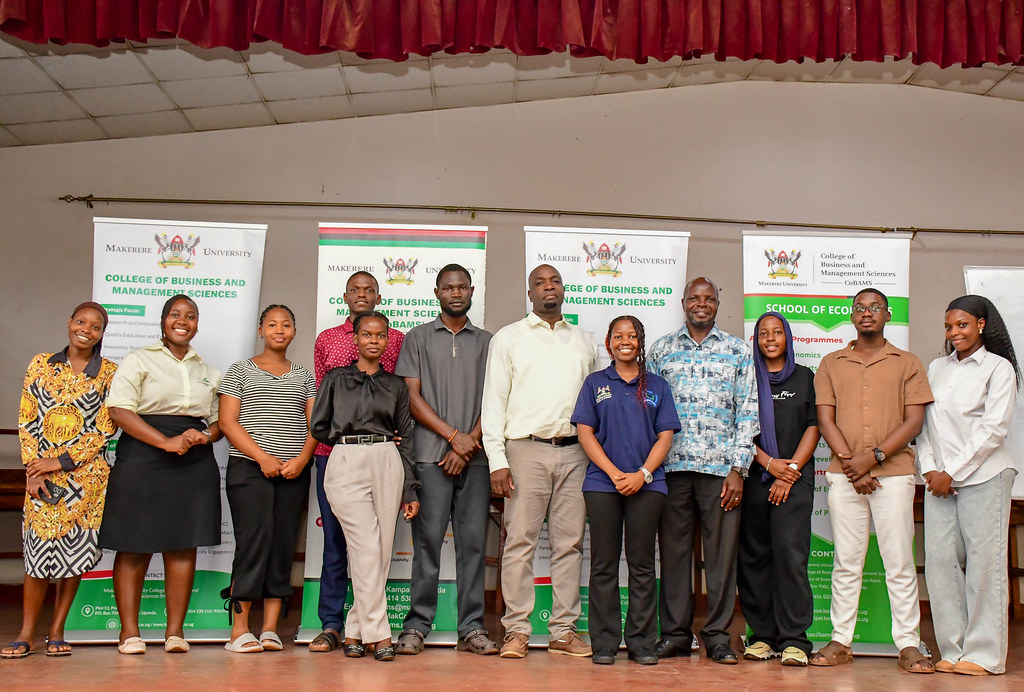
By Ritah Namisango and Moses Kibirango
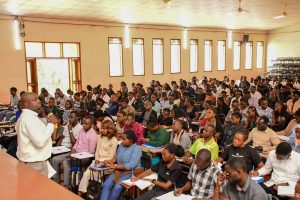
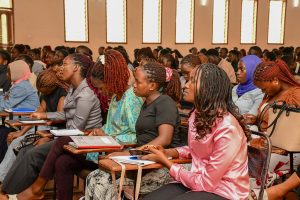
Over 350 third-year students (finalists) at Makerere University were urged to unlock their entrepreneurial potential and navigate the real-world business market during a specialized guest lecture on campus.
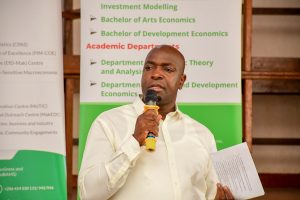
The engagement, held on 20th October 2026, was part of the Development Economics (ECO 3112) course, facilitated by Dr. Fred Matovu, an Associate Professor at the School of Economics under the College of Business and Management Sciences (CoBAMS).
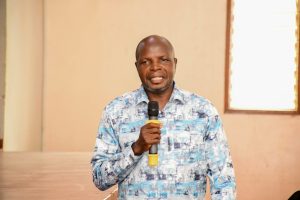
The session featured Mr. David Ssegane, the Managing Director of Makindye-based M-Products Bakery, who delivered a keynote presentation titled: “Entrepreneurship-Identifying, Starting, and Running a Business.”
Re-Awakening the Entrepreneurial Spirit
The lecture targeted third-year students pursuing various economics pathways, including the Bachelor of Arts in Economics, Bachelor of Science (Economics), Bachelor of Science with Education (Economics), and Bachelor of Arts with Education (Economics).
According to Dr. Matovu, the initiative aimed to re-awaken the students’ entrepreneurship mindsets as they prepare to transition from academia to the world of work.
Real-World Business Insights
Mr. Ssegane is a graduate of Makerere University. He studied BSc (Fisheries and Aquaculture) at the College of Natural Sciences and graduated in 2010. He informed the students that he applied the knowledge from his university education to his bakery business, including introducing information technology systems.
Drawing from his lived experiences of successfully sustaining a bakery in Kampala’s highly competitive market, Mr. Ssegane shared critical insights on managing employees, optimizing resource utilization, and maximizing profits through efficiency and cost minimization.
During the interactive session, the bakery chief outlined the fundamental rules governing entrepreneurship and the financial culture required to sustain a startup. “You must understand the do’s and don’ts of the game, master the culture of money, and safeguard your business plans from unnecessary disclosure,” Mr. Ssegane advised the finalists.
The Gist of the Entrepreneurship Lecture
Featuring the two facilitators namely Mr. Ssegane and Dr Matovu, the lecture focused on the importance of setting measurable personal goals, developing market-relevant skills, learning from experienced professionals and taking deliberate steps towards turning ideas into viable businesses.
Dr Matovu encouraged the students to develop personal development plans with realistic targets and measurable indicators to track their progress, identify weaknesses and guide their professional growth.
He advised students to identify mentors and seek guidance from experienced professionals to help them navigate career choices and professional challenges.
Drawing from his own journey, he explained that professional success does not always follow a predetermined path. Dr. Matovu disclosed that while he initially aspired to become an engineer in high school, he was admitted to a Bachelor of Science program-studying Economics, Mathematics, and Psychology in his first year-before transitioning to the Economics 3.1.1 combination (as it was known in the early 1990s). He subsequently pursued Master’s and PhD degrees in Economics.
After university, Dr Matovu faced difficulties finding employment and subsequently worked in a bakery for one year. He said the experience exposed him to manual work and interactions with different people, lessons that equipped him with the knowledge and tactic of working with people of different background and level of education.
His career subsequently developed towards Health Economics after he received a fellowship from the African Capacity Building Fund (ACBF). He pursued his studies and attained a doctorate (PhD) from the London School of Hygiene and Tropical Medicine, Univeristy of London and has published research in health economics.
Dr Matovu cited competence, role models, professional networks, flexibility and adaptability as important factors in navigating his career. His experience illustrated how graduates can adjust their ambitions as they gain new skills, encounter opportunities and respond to changing circumstances.
Entrepreneurhip: Start Small and Build your Skills
Mr. David Ssegane advised the students seeking financial independence to identify their interests, assess opportunities within the communities and start businesses on a manageable scale rather than pursuing quick financial gains.
Mr. Ssegane explained that passion could be developed over time and did not necessarily have to be present from the beginning. He attributed his own interest in baking to the influence of his parents.
“When you get to the point of getting money, then your passion can be identified,” said Mr. Ssegane. “Understanding your passion helps you identify the business you want to do.”
He encouraged graduates to identify opportunities that align with their academic backgrounds, abilities and local economic conditions. For example, he cited Masaka, where coffee provides a potential business opportunity.
Mr. Ssegane urged aspiring entrepreneurs to study and seek additional education, information and knowledge in the particular area of interest or business that they would like to start. “Understand your chosen field, exchange ideas in groups and use business platforms to acquire information,” he guided.
Tackling the issue of financing of the entrepreneurship or business idea, Mr. Ssegane implored the students to identify affordable sources of capital, and underscored the importance of starting small while maintaining consistency.
“A marathon cannot be run in a few seconds,” he said, urging entrepreneurs to prioritise long-term progress over immediate financial rewards.
He encouraged the business owners to save, maintain financial discipline, and separate personal affairs from business operations. He said enterprises needed systems that allowed them to operate independently rather than rely on personal relationships or family attachments.
Resilience, Customer Research and Financial Discipline
Mr. Ssegane emphasised that sustaining a business required discipline, continuous learning and the ability to adapt to changing economic conditions.
Responding to a question about maintaining consistency during economic downturns, Mr. Ssegane identified reducing operational costs as the best approach for businesses to remain resilient. He discussed measures taken in his business to reduce costs such as reduing the number of employees, hiring a few competent employees, and enforcement of business systems.
His remarks highlighted the importance of balancing cost management with the need to maintain an enterprise’s capacity to serve customers and generate revenue.
Managing the Challenge of Joining an Established Market and Competition
Acknowledging that competing with existing businesses is a major challenge, Mr. Ssegane advised entrepreneurs to understand their customers, identify their needs and improve their products or services in response to customer dissatisfaction.
He stressed the importance of market surveys and continuous analysis, encouraging entrepreneurs to identify a specific market segment and establish systems that support sustainable operations.
Responding to the question on attracting customers without giving away product samples, Mr. Ssegane said businesses needed to allocate resources to marketing.
He advised entrepreneurs to build a business culture based on trust and networking, seek guidance from reliable mentors and concentrate their efforts on developing one business before expanding into others.
“Be consistent, resilient but not blind,” he said, urging business owners to remain persistent while recognising when circumstances require them to adjust their strategies.
Cautioning the students against get-rich-quick schemes, including betting, Mr. Ssegane encouraged the students to make deliberate financial decisions. He urged them to learn the rules and culture of money, protect their business plans from unnecessary disclosure and develop the confidence to decline demands that could undermine their priorities. “Learn to say no and don’t feel guilty,” he said.
Emphasising the importance of taking action, Mr. Ssegane observed that people have “three days namely yesterday, today and tomorrow,” but cannot be certain of tomorrow. He encouraged his audience to put the lessons into practice without unnecessary delay.
Students appreciate the practical lessons in Entrepreneurship
The students who attended the lecture appreciated the discussion for widening their understanding of entrepreneurship and the importance of applying academic knowledge to real-world challenges.
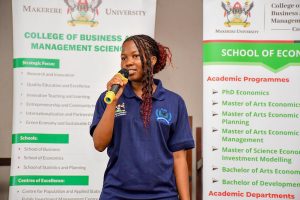
Ms. Nandudu Anitah Angel, a Bachelor of Arts in Economics student at the College of Business and Management Sciences (CoBAMS), thanked Mr. Ssegane for generously sharing his time and knowledge with students. Ms. Nandudu highlighted the value of interactive learning in connecting economic theory with practical business decisions. She said the interaction demonstrated the importance of a mindset shift and the willingness to learn and unlearn. She noted that encouragement and support from reliable personalities could help people to gain the confidence to turn their dreams into reality.
Additionally, Ms. Nandudu appreciated the way Dr Matovu developed a question about starting and managing a business into an interactive discussion that encouraged students to consider how economics could be applied in everyday life.

Mr. Wilson Sseruwagi, the President of the Makerere Economics Society, challenged fellow students to explore business opportunities before completing their studies. “Start small, turn skills into solutions and learn as you grow, because with discipline and consistency, an idea can become a source of income,” he said.
Ms. Tusiime Mary Mercy, a third-year student pursuing the Bachelor of Arts with Education (majoring in Economics) and who is also a class representative, testified that the lecture equipped her with the knowledge and confidence to start a business regardless of her professional background.
The students’ reflections reinforced the speakers’ message that entrepreneurship requires more than identifying a business idea. It involves learning from experience, developing the confidence to act and applying practical skills to address market needs.
Turning Ambition into Measurable Progress
The lecture combined career development and entrepreneurship as complementary approaches to preparing students for life after university. While Dr Matovu’s experience demonstrated the value of flexibility, professional development and mentorship,Mr Ssegane’s advice focused on the practical demands of establishing and sustaining a business.
Both perspectives underscored the need for students to plan deliberately, assess their progress and seek advice from people with relevant experience.
For aspiring entrepreneurs, the message was to identify opportunities within their communities, apply the knowledge gained at university and build businesses gradually through consistent effort, financial discipline and customer-focused decision-making.
For students preparing for different career paths, the discussions also highlighted the importance of remaining adaptable, setting measurable goals and recognising that professional growth can emerge from unexpected experiences.
The lecture encouraged students to move beyond discussing their ambitions and begin taking practical steps towards achieving them.