By Ritah Namisango and Monica Meeme
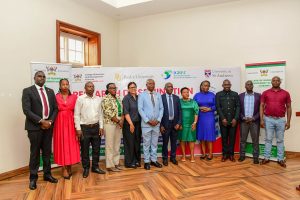
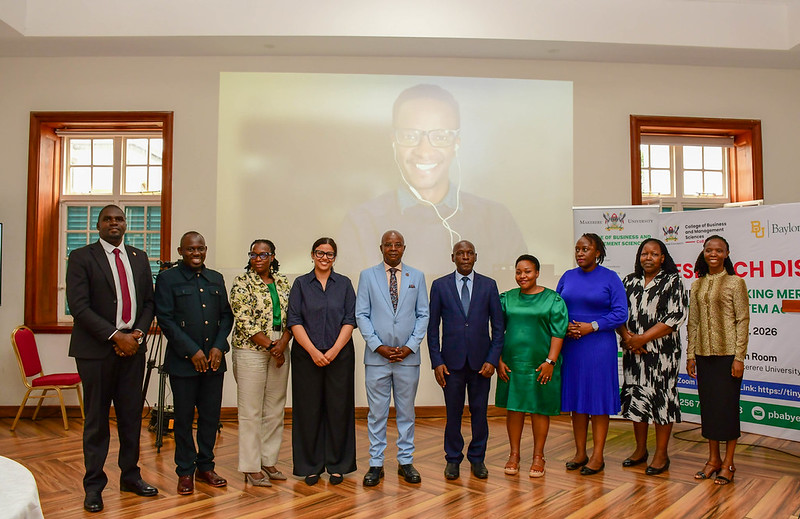
Sept 14, 2026: Makerere University College of Business and Management Sciences (CoBAMS) in collaboration with Baylor University, International Growth Research and Evaluation Center (IGREC) and the University of St Andrews, convened a research dissemination workshop titled: Re-thinking Merit-Gender, Quotas, and the making of STEM access at the University.
The hybrid dissemination workshop brought together stakeholders from the education field, experts in gender and planning, media and communication practitioners, as well as undergraduate and graduate students at Makerere University to interface with the findings of the research and to examine how gender quotas and affirmative action are reshaping access to Science, Technology, Engineering and Mathematics (STEM) programmes at the university.
Focus of the research on the Gender Quota in STEM
The presentations and plenary discussion during the hybrid dissemination workshop focused on the Makerere University gender quota policy, which ring-fences 40 percent of student enrollment places in all Science, Technology, Engineering, and Mathematics (STEM) disciplines for female students. The policy approved by Makerere University Council in 2019 was informed by the desire to increase the number female students studying STEM courses.
The research team consisting of Assistant Professor Saloni Chopra, Assistant Professor Isaac Ahimbisibwe, and Professor Edward Bbaale engaged the participants with findings and research outcomes that examined the effects of the policy at Makerere University, and at another University outside in Uganda. The presentations included: The upstream effects of gender quotas, the academic outcomes of gender quotas in engineering, and the downstream effects of gender quotas in STEM.
The forum examined how Makerere’s 40% female enrollment quota in STEM interacts with academic merit, student application behavior, perceptions, choices, and systemic barriers. For instance, the researchers established that at the University, greater women balance does not affect academic performance.
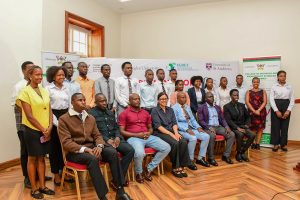
Opening the dissemination workshop, Professor Edward Bbaale called upon the participants to follow the policy across the entire chain. “We need to reflect on the need for Affirmative Action before the University, what happens to academic performance when women enter the University, and whether this ultimately affects the labour market and social outcomes after graduation,” he said.
Gender Quotas make STEM more Attractive to Women
Commencing his presentation titled “The upstream effects of gender quotas,” Assistant Professor Isaac Ahimbisibwe from the University of St Andrews observed that the Makerere University gender quota policy made STEM programmes more attractive to female students, prompting more women to rank STEM courses among their preferred choices.
“The Makerere University gender quota policy requires women to constitute at least 40 percent of admitted cohorts in programmes where they have historically been underrepresented,” he said.
He noted that women remain significantly underrepresented in STEM globally, despite women matching or exceeding men in university enrolment in many countries. He explained that the gender gap persists even among academically qualified students, with equally qualified female students often less likely to choose STEM programmes.
He stressed that women’s ranking of STEM programmes at Makerere University increased by about six percentage points, with some students shifting from other universities and from non-STEM programmes.
Reporting the increased interest in some STEM programmes that were already relatively gender-balanced, he stated that the policy may have influenced perceptions of STEM opportunities more broadly.
Gender Quota Increases Women’s STEM Enrolment Without Compromising Quality

In a presentation titled “The academic outcomes of gender quotas in engineering, and the downstream effects of gender quotas in STEM,” Assistant Professor Saloni Chopra said the gender quota policy has significantly increased women’s access to and enrolment in male-dominated STEM programmes without compromising academic quality.
The research, conducted by Chopra and Ahimbisibwe, examined both the upstream and downstream effects of the gender quota policy introduced at Makerere University in 2020.
The findings showed that the policy increased the proportion of women admitted to affected STEM programmes by nearly 10 percentage points, with a similar increase in the number of women who eventually enrolled.
She said Makerere University’s gender quota policy has significantly increased women’s access to and enrolment in male-dominated STEM programmes, while also improving overall academic outcomes.
Chopra explained that the increase was partly achieved through different admission cut-offs for female and male applicants in historically male-dominated programmes. She said the findings challenge concerns that admitting students with lower entry scores would reduce the overall quality of university cohorts.
STEM Interventions Beyond University Admission

Commenting on the findings, Professor Edward Bbaale, the Principal,College of Business and Management Sciences (CoBAMS), said the research strongly resonates with the work of the Academic Registrar, particularly ongoing efforts to mainstream gender across the University.
In a very special way, Bbaale acknowledged the input from the staff members in the Department of the Academic Registrar namely Professor Buyinza Mukadasi-the Academic Registrar, Mr. Charles Ssentongo, Mr. Justus Karegyeya and the entire team, which significantly informed the study findings and research processes.
He stressed that gender quotas should go beyond increasing women’s admission into STEM, arguing that affirmative action alone cannot remove the broader barriers that prevent women from entering, remaining in and succeeding in STEM.
“Affirmative action must go beyond access. We need interventions before, during and after university graduation to ensure women’s sustained participation and success in Uganda’s STEM economy,” he said.
Bbaale called for interventions across the education and career pipeline, including better information about STEM opportunities before joining the university, financial support during university and measures to strengthen women’s transition into and success in the labour market.
Call for Stronger Link between STEM Education and Employment

Mr. Derrick Mbalule from the National Planning Authority (NPA) commended the researchers for examining the policy chain from students’ choices and university admission to academic performance and eventual labour-market outcomes.
He said the findings raise important questions about who benefits from scaling affirmative-action interventions and how those benefits translate into employment and national development.
Mbalule stressed the importance of understanding the transition from education to employment, particularly as Uganda seeks to address shortages in critical skills. He urged researchers to examine the occupations graduates eventually join and the factors influencing employers’ recruitment decisions.
He also questioned the extent to which A-level results predict future academic and professional performance, particularly as Uganda’s education system increasingly embraces continuous assessment and competency-based approaches.
He encouraged universities and government institutions to strengthen the use of education and employment data to monitor graduate outcomes and inform human-resource planning.
Advocating for Stronger STEM Policies

During his submission, Mr. Charles Ssentongo, former Deputy Academic Registrar in charge of Undergraduate Admissions and Records at Makerere University commended the research for its insightful findings. He advocated for stronger policies to support the implementation and advancement of STEM education at the University.
Emphasizing the role of admission cut-off points, Mr. Ssentongo noted the need to consider students’ interests and attitudes towards STEM alongside academic performance when determining admission criteria, to realize greater participation in STEM programmes.
Regular Sensitization on Gender Stereotypes

Contributing to the discussion, Dr Marjorie S. K. Batiibwe, Head Department of Science, Technology, and Vocational Education (DSTVE), who represented the Dean, School of Education, Associate Professor Mathias Mulumba Bwanika called for increased sensitization to challenge gender stereotypes that limit women’s participation in the job market, particularly in the STEM fields.
“Employers need to recognize that women have the skills and potential to perform effectively in roles traditionally viewed as male-dominated,” she urged.
Gender Gaps in STEM Begin Before University

Dr Lillian Tukahirwa from the Gender Mainstreaming Directorate (GMD) at Makerere University called for gender interventions to begin at the family and community level, noting that many barriers to girls’ participation in STEM emerge long before they reach university.
She pointed to family expectations, community attitudes and gender stereotypes as factors that can influence girls’ confidence, subject choices and aspirations, particularly in physics and other male-dominated STEM fields.
Tukahirwa called for stronger support for physics education, improved teacher preparation and greater sensitisation of parents, mentors, educators and employers to challenge stereotypes affecting women’s participation in STEM.
Community Action and prioritizing Physics Education

Associate Professor Ruth Nsibirano from the Institute of Gender and Development Studies (IGDS) at Makerere University stressed that the barriers limiting girls’ participation in STEM begin long before university and are deeply rooted in family and community socialisation.
She noted that some girls grow up in environments where their education is undervalued, marriage is prioritised and they are discouraged from pursuing science subjects, particularly when they encounter difficulties in mathematics.
She called for stronger engagement with parents, guardians, mentors and peers to build girls’ confidence, provide positive role models and encourage them to appreciate the value of STEM education and careers.
She also raised concern about the low participation of girls in physics, urging policymakers to examine teacher training institutions, including the subjects’ teachers choose to specialise in. She called for greater investment in physics teaching, practical resources and teacher capacity.
She noted that gender stereotypes persist into the labour market, where some employers may still perceive certain careers as more suitable for men than women. She called for sustained awareness and sensitisation targeting students, parents, teachers, universities and employers.
Expand Opportunity for Disadvantaged Students

Delivering the closing remarks, the Dean of the School of Economics, Associate Professor Ibrahim Mike Okumu, highlighted the role of affirmative action in helping talented but economically disadvantaged students overcome financial barriers to university education.
Drawing from his experience, Okumu noted that academic ability alone does not always guarantee access to higher education when students face affordability challenges.
He said targeted scholarships and affirmative-action measures can therefore help unlock talent, improve livelihoods and promote socio-economic mobility. He lauded the research team, noting that the findings are essential for policies aimed at widening educational opportunities and strengthening STEM participation.

Moderated by Dr Peter Babyenda, Policy and Engagement Coordinator at the College of Business and Management Sciences (CoBAMS), and Ms Ritah Namisango, Principal Communication Officer at Makerere University, the dissemination workshop held at Makerere University with physical and online participants, presented to participants an opportunity to critique and provide valuable input into the research in progress on Re-thinking Merit: Gender, Quotas, and the making of STEM access at the University.
Pictorial: