
By Monica Meeme and Ritah Namisango
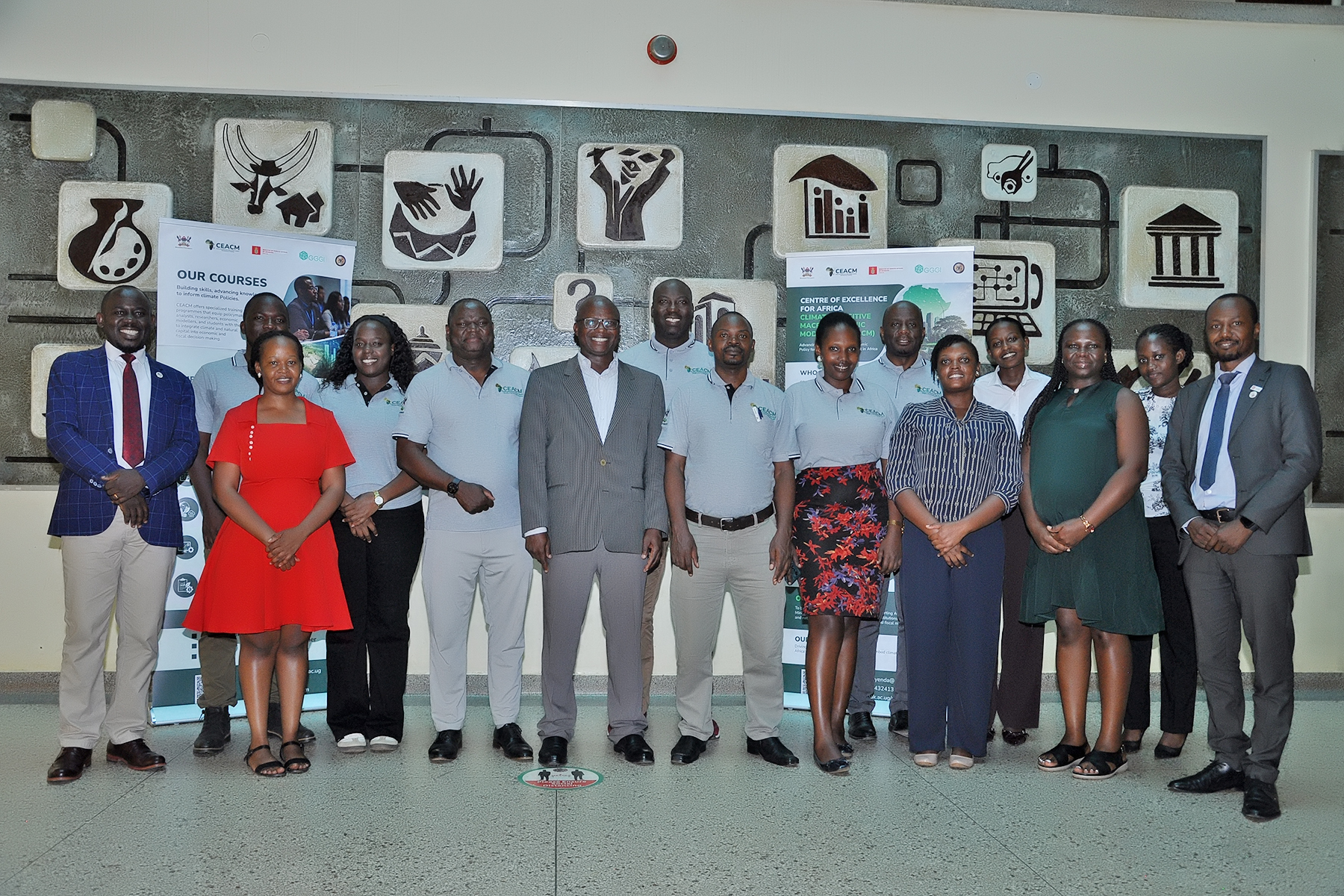
From 19th to 23rd October 2026, the Makerere University Centre of Excellence for Africa Climate-Sensitive Macroeconomic Modelling (CEACM) conducted an intensive training in Macroeconomic Modelling of Natural Capital Accounts.
The training which brought together ten (10) participants from Uganda, Malawi, Sierra Leone was facilitated by seasoned facilitators from CEACM, including Prof. Wilson Asiimwe, Ms. Suzan Ainyo, and Ms. Comfort Akakwasa.
CEACM is hosted at Makerere University under the College of Business and Management Sciences (CoBAMS) in collaboration with the Ministry of Finance, Planning and Economic Development (MoFPED)
The five-day course aimed at equipping participants with practical skills in economy-wide modelling, Social Accounting Matrices (SAM), multiplier models, and policy analysis of investments in natural capital assets to support evidence-based climate policy analysis and decision-making.
Officially opening the training on 19th October 2026, Prof. Edward Bbaale, the Principal, College of Business and Management Sciences (CoBAMS), highlighted that strengthening the collective capacity to integrate natural capital into macroeconomic decision‑making is a priority that is increasingly vital for Africa’s sustainable development.
“Given that most of African Countries are resource rich. African economies depend heavily on forests, land, water, biodiversity, minerals, and ecosystem services. Yet, too often, the contribution of these assets to production, employment, household welfare, and fiscal revenues is overlooked in conventional macroeconomic analysis,” he said.
According to Prof. Bbaale, the objectives of the training focused on equipping the Ministries of Finance in Africa, universities, and policy institutions with the tools to make natural capital visible in macroeconomic decision‑making.
“Through this course, we are bridging the capacity gaps in the macroeconomics of natural capital assets. This strategic approach feeds into the Pan‑African Finance Ministers Forum for Climate Action (PAFCA) road map,” he said.
The intensive course covered six (6) thematic areas: Matrix Applications for Economy-Wide Modelling, Structure and Application of Social Accounting Matrices, Building SAM-Based Multiplier Models, Integrating Natural Capital Assets into Multiplier Models, Policy Analysis of Investments in Natural Capital Assets, and Policy Simulation, Results Interpretation and Communication.
Prioritize Integration of Natural Capital into Economic Decision-Making
The Principal of the College of Business and Management Sciences (CoBAMS), Prof. Edward Bbaale, urged African policy analysts and researchers to actively integrate natural capital into national economic planning.
His remarks were delivered by the College Deputy Principal, Assoc. Prof. James Wokadala, during the closing session of the climate-sensitive economic modelling training on 23rd October 2026, in the EfD Board Room at Makerere University.
Prof. Bbaale emphasised that natural capital is no longer just an environmental concern, but a critical economic asset that must drive national budgeting and investment decisions across the continent.
Becoming Ambassadors of Change
Assoc. Prof. Wokadala implored the participants to become ambassadors of economic modelling within their respective institutions. He challenged them to share their knowledge with colleagues and translate their new skills into practical policy solutions.
“The success of this training will be measured by the policies, research, and investments informed by the knowledge gained,” Wokadala stressed.
The Deputy Principal commended the Centre of Excellence for Africa’s Climate-Sensitive Macroeconomic Modelling (CEACM) leadership, staff, and the facilitators for their vital role in building capacity for climate-sensitive economic modelling across Africa.
Champion Evidence-Based Policymaking through Natural Capital Modelling
Dr Peter Babyenda, Programmes Coordinator at the Centre of Excellence for Applied Climate and Macroeconomic Modelling (CEACM), emphasised the importance of the training, highlighting it as an important step towards building technical capacity and strengthening collaboration among African researchers and institutions.
“The training was part of broader efforts to build local expertise, nurture emerging researchers and increase the contribution of research to national and regional development,” he added.
Underscoring the Centre’s commitment to expanding research, training, and partnerships with African universities, Dr Babyenda highlighted opportunities to strengthen natural capital modelling through artificial intelligence (AI) and other analytical tools. He urged researchers and policymakers to apply these models to promote evidence-based decision-making and sustainable development.
Dr Babyenda encouraged participants to apply the practical skills acquired during the training, continue sharing knowledge, and strengthen their professional networks to advance natural capital accounting and its integration into policy decisions.
Integration of Natural Capital into Uganda’s Fiscal Planning
In an interview with the College Communications Office, Prof. Wilson Asiimwe, a facilitator from CEACM stressed the need to integrate natural capital assets into Uganda’s macro-fiscal models to help assess the economic and fiscal risks associated with environmental degradation and climate change.
“The depletion of natural resources and increasing climate-related shocks pose significant challenges to Uganda’s economy and public finances,” he noted.
Prof. Asiimwe highlighted that climate change has been identified as a major source of fiscal risk in Uganda’s fiscal statements, underscoring the importance of strengthening evidence-based economic planning and policy decisions.
A Participant’s Perspective: Integrate Natural Capital into Policy Decisions
Mr. Hilton Msamali, one of the participants from the United Nations Development Programme (UNDP) in Malawi, described the training as immensely rewarding.
Mr. Msamali applauded the facilitators and urged his fellow participants to actively apply their new skills to address existing data gaps, strengthen the role of natural resources in national development, and elevate Africa’s voice in global decision-making.
“The knowledge gained will help Malawi assess how natural resources contribute to development projects, strengthen evidence-based policymaking, and identify gaps in data collection,” Msamali said.
Highlighting the overarching importance of natural capital modelling, he emphasised that reliable, detailed, and disaggregated data is absolutely vital to improving assessments and guiding informed decisions across both the public and private sectors.
Call for Continued Learning and Collaboration
Appreciating the planning and facilitation teams, Dr. Jude Sebuliba, a faculty member at the College of Business and Management Sciences (CoBAMS), described the programme as both timely and valuable, noting that it benefited international participants alongside local students, researchers, and lecturers.
He commended the facilitators for delivering the training with passion, patience, and accountability, emphasizing that their commitment far exceeded everyone’s expectations.
Moderated by Ms. Rhoda Kahita from the CEACM Secretariat, the training provided a dynamic platform for knowledge exchange, practical learning, and collaboration, ultimately strengthening regional natural capital modelling to promote evidence-based policymaking across Africa.
About the Course
The “Macroeconomic Modelling of Natural Capital Assets” course focused on integrating natural capital assets into macroeconomic analysis using Social Accounting Matrix (SAM)-based multiplier modelling to assess their contribution to production, employment, household income, and economic resilience. Through practical modelling exercises, participants gained skills in analysing natural capital investments and generating evidence to inform economic policy and sustainable development.
Writers: Ms Ritah Namisango is a Principal Communication Officer at Makerere University. Ms. Monica Meeme serves as a volunteer in the College Communication Office. Having completed her fourth year of a Bachelor of Journalism and Communication, she is currently awaiting graduation in January 2027.
Future reference notes: Event-CEACM Training in Macroeconomics Modelling of Natural Capital Assets, Dates: 19th to 23rd October 2026, Venue: EfD Board Room at Makerere University.