
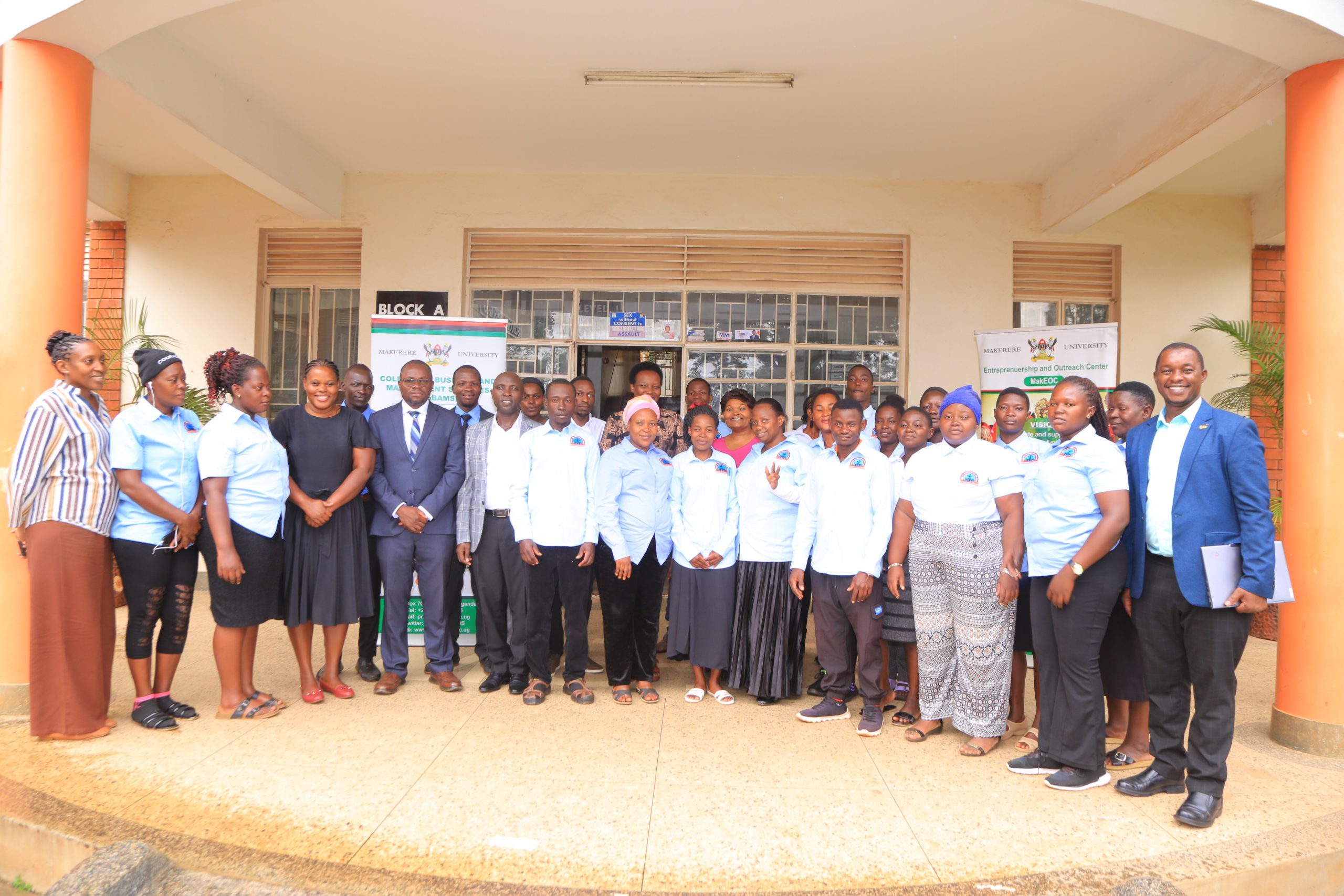
Over 40 youth from Better Tomorrow for the Deaf Limited completed a two-day intensive entrepreneurship training at Makerere University.
The training conducted on the 28th and 29th May 2026 equipped the youth with hearing impairment with practical skills to start and manage businesses.
Facilitated by the Makerere University Entrepreneurship and Outreach Centre, in partnership with the Department of Marketing and Management within the School of Business, under the College of Business and Management Sciences (CoBAMS), the training covered the following modules: Starting and Growing a Business, Business Model Canvas, Creativity and Innovation, and Financial Literacy and Resource Mobilization.
The facilitators included: Dr. Sarah Bimbona, Dr. Marion Nanyanzi, Dr. Kasimu Sendawula, Dr. Cathy Mbidde, and Dr. Festo Nyende.
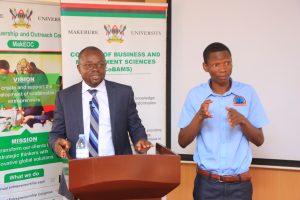
The Opening ceremony was witnessed by the Dean, School of Economics-Associate Professor Ibrahim Mike Okumu, who represented the Principal CoBAMS and Dr. Jude Tadeo Mugarura-the Head of Department for Marketing and Management.
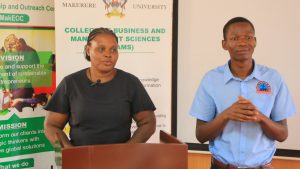
According to Dr. Sarah Bimbona, the mandate of the Centre, is to support stakeholders in entrepreneurship knowledge and skills, and to reach out to communities that are often excluded from economic opportunities.
“When we were approached by a group of entrepreneurs with hearing impairment, we opened our doors, brought them to Makerere University, and started working with them to build their business skills.”
“Inclusion is not charity, but a strategic investment. This group approached us because they lacked access to business training in sign language. Now we are teaching them how to start, manage, and grow businesses, from registration to tax compliance.”
She revealed that as the Makerere University Entrepreneurship and Outreach Centre marks 10 years in October, it will offer the group free exhibition space to evaluate and assess the impact of the training.
Representing the Principal of the College of Business and Management Sciences, Prof. Edward Bbaale, the Dean of the School of Economics, Associate Professor Ibrahim Mike Okumu, advocated for productive opportunities for the youth. “Without productive opportunities for the youth, Uganda risks raising a new generation trapped in poverty,” he said.
He urged formalization and innovation, asking how businesses can scale from basic tools such as welding machines to efficient equipment. He said Uganda’s move to middle-income status is real and starts with individual financial growth.
He praised the training for advancing Makerere’s inclusive strategic goal and observed that entrepreneurship is about building confidence, creativity, and lasting livelihoods, not just launching businesses.
Dr. Betty Tuhaise, a member of faculty from the Department of Accounting and Finance at Makerere University, urged trainees to turn challenges into opportunities.
Dr. Tuhaise said: “Life sometimes can give you a lemon, but you can make juice out of that lemon, which we call lemonade, and the juice is better.” She emphasized resilience and vision beyond physical ability: “Even us that seem to be hearing, sometimes we don’t hear enough. There is capacity to see beyond what is visible. I equally believe we can hear beyond the physical hearing.”
At the commencement of the training, Dr. Cathy Mbidde challenged the trainees to focus on readiness and practical action as they build enterprises.
“Before you start, you should find out whether you are ready. Not just seeing other people doing it, and then you also go and do.” She emphasized that success depends on personal attributes and environment: “The success of your business will depend on your personal characteristics, your skills, the environment around you, your friends, your family.”
In another session, Dr. Marion Nanyanzi said creativity and innovation are essential for business survival in a competitive market.
“With stiff competition, you must understand that you are not the only player in the market. If you ignore creativity and innovation, competitors will throw you out.”
“The market is dynamic. Customer tastes and preferences change every day. The only way to cope is by being creative and then going the extra mile to implement those ideas. Don’t stop at thinking. Use your hands to put things into reality.”
She added that satisfying customers builds loyalty, which leads to increased sales, higher profits, bigger market share, and long-term business survival.
The team also explored the Business Model Canvas, a practical one-page planning tool for entrepreneurs, facilitated by Dr. Kasimu Sendawula.
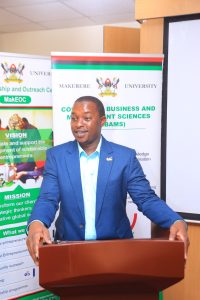
It visually maps all key components of a business on a single page. Dr. Sendawula outlined its nine building blocks: key activities, key partners, value proposition, customer relationships, customer segments, channels, key resources, cost structure, and revenue streams.
Mr. Ssempa Wilson from Better Tomorrow for the Deaf Ltd thanked Makerere University and challenged stereotypes about disability and entrepreneurship.
He traced the organization’s 1992 origins to befriending a ridiculed deaf classmate Timo: “I told myself, when I grow up, I will start a school… The deaf and others with impairments can do what we do.”
He noted the isolation deaf entrepreneurs face: “Each person you see here has a story, and we have over 100 more… If people without hearing impairments struggle, what about them? They have nowhere to turn.”
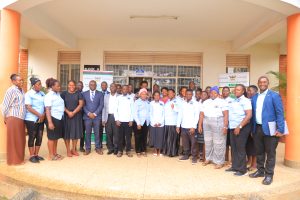
He urged the trainees to grow: “This is our day to learn how to live in our communities, run our small businesses, and grow them bigger… so we can lift ourselves alongside the hearing community.”
According to the feedback interpreted by their sign language specialist, the participants said they benefited significantly from the sessions.
About Makerere University Entrepreneurship and Outreach Centre
The Centre is Makerere’s open door for business. When youth and excluded groups arrive, it teaches planning, innovation, finance, and compliance with sign language support. It then links them to real markets through exhibitions.
Mr. Julius Tukacungura contributed to this story as a Guest Writer