
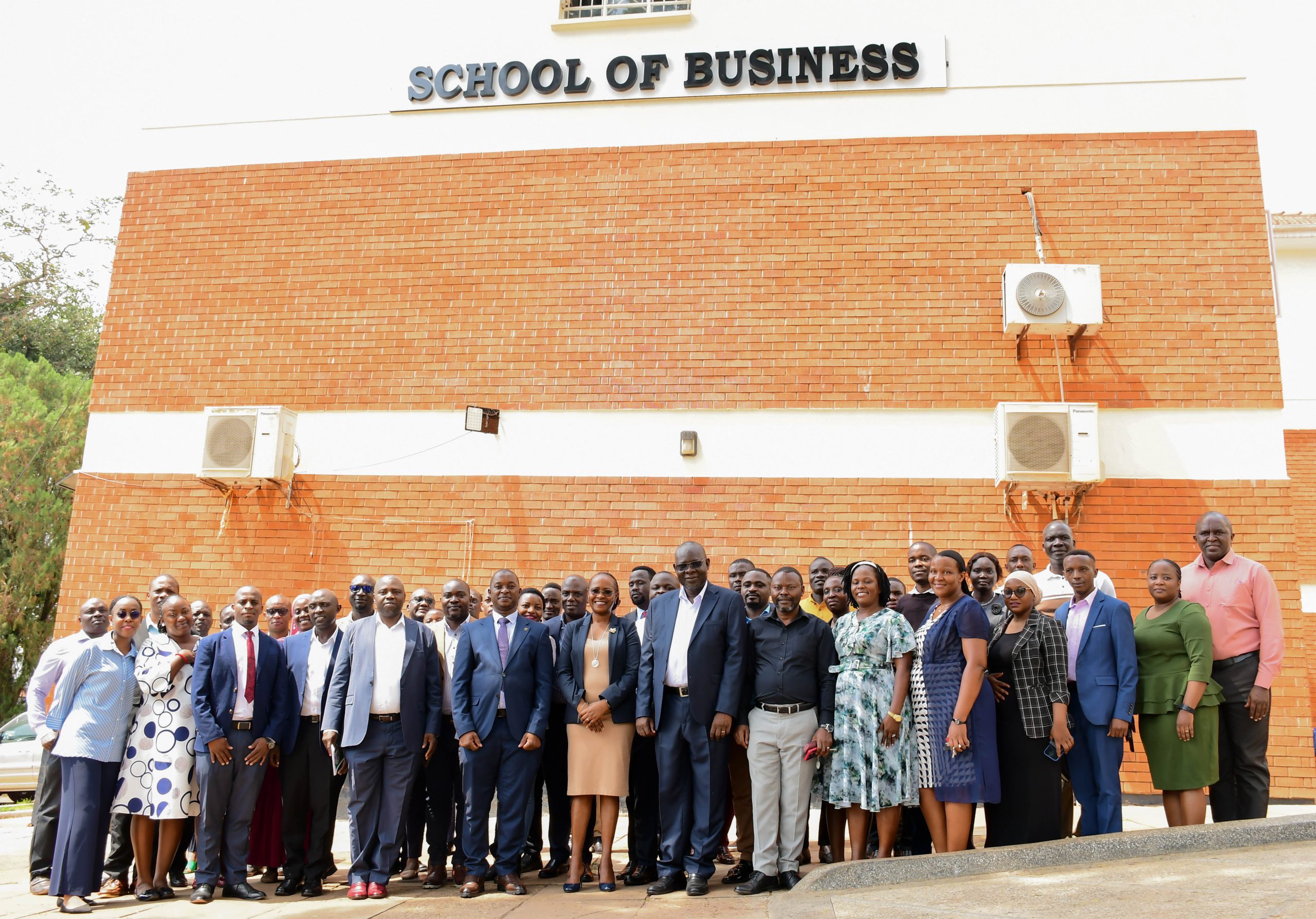
“New doctoral students urged to pursue research that delivers solutions to Uganda’s socio-economic challenges.”
Makerere University has launched two new taught Doctor of Philosophy (PhD) programmes namely: The PhD in Management (by coursework) and the PhD in Accounting and Finance (by coursework).
The programmes, launched on 4th August 2026, under the School of Business at the College of Business and Management Sciences (CoBAMS), are among the first taught PhD programmes in the two disciplines in Uganda.
The launch was presided over by Makerere University Deputy Vice Chancellor for Academic Affairs, Prof. Sarah Ssali, during a three-day orientation programme for the inaugural PhD students running from 4th to 6th August 2026.
Prof. Ssali challenged the new scholars to pursue evidence-based research addressing pressing challenges facing Uganda and the wider world.
“Choosing to pursue a PhD is not an ordinary decision. It is a commitment to becoming part of an institution with a rich history of research, innovation and knowledge creation,” Prof. Ssali said.
She told the students that the purpose of doctoral training should go beyond acquiring academic qualifications, urging them to focus on solving real-world problems.
“A PhD should prepare you to solve problems. You should ask yourselves: ‘What problem am I trying to solve?’ Research should not simply produce another thesis that sits on a shelf in the library. It should generate knowledge, products, services, policies and innovations that improve people’s lives,” she said.
Prof. Ssali explained that research outputs should not only be physical products, but could also include frameworks, management systems, policies and models that transform society.
“For those in the service disciplines, your product could be a framework, a model, a policy, a management system or a new way of delivering services that changes how society functions. That is why we do research,” she said.
She urged the scholars to remain committed throughout their doctoral journey, noting that persistence and discipline are critical to completing a PhD.
“A PhD requires commitment. It requires discipline. It requires sacrifice. Success in a PhD is determined by persistence,” Prof. Ssali said.
She encouraged students to embrace critical thinking and challenge existing ideas through evidence-based inquiry.
Prof. Ssali implored the scholars to focus their research on areas that can contribute to economic transformation, including agriculture, manufacturing, taxation, supply chains, governance, finance, climate change and technology.
“Uganda faces many challenges, but every challenge is also an opportunity for research. Research should not stop at identifying problems. It should propose practical, implementable solutions,” she said.
Makerere positions graduate training at centre of research agenda
The Principal of CoBAMS, Prof. Edward Bbaale, described the launch of the programmes as a major milestone in Makerere University’s agenda to strengthen its position as a research-intensive institution.
Prof. Bbaale said the PhD programmes represent a strategic investment in developing researchers, innovators and academic leaders.
“Today’s occasion is very significant because it marks the launch of the taught Doctor of Philosophy in Management and the Doctor of Philosophy in Accounting and Finance programmes,” he said.
“These are among the first taught PhD programmes in these disciplines in Uganda, and we are very proud of this achievement.”
He commended the School of Business leadership and faculty for developing the programmes, acknowledging that establishing doctoral programmes requires commitment, teamwork and dedication to academic excellence.
He observed that the programmes align with Makerere’s strategic goal of becoming a research-led university.
“Graduate training must be at the centre of that transformation. Events like this one—the admission and orientation of PhD students—are exactly the kinds of activities that define a research-intensive university,” he said.
Prof. Bbaale encouraged the first cohort students to publish their research in reputable journals and complete their studies within the required period.
“Complete your coursework successfully. Progress through your research diligently. Graduate within the required period. Publish your work in reputable, high-impact journals. Your success will create a strong foundation upon which future cohorts will build,” Prof. Bbaale said.
He guided that doctoral research should provide evidence to guide national decision-making.
“There is a great demand for evidence-based policy advice in Uganda. Government needs researchers who can provide evidence, not simply opinions,” he said. “Your research should generate evidence upon which decisions can be made.”
School of Business welcomes pioneer cohort
The Dean of the School of Business, Associate Professor Godfrey Akileng, welcomed the students and described the programmes as part of the school’s continued growth in graduate training.
“We are delighted to welcome you as you begin this journey with us. We hope that you will stay with us throughout the next three years of your PhD studies,” Assoc. Prof. Akileng said.
He asserted that the doctoral journey would be demanding, but assured students of support from the faculty.
“The programme is demanding, and the research component will be very intensive. Our hope is that we shall walk this journey together and, three years from now, celebrate your graduation as one cohort,” he said.
He highlighted that a PhD is about knowledge creation rather than simply earning a title.
“A PhD is not about being called ‘Doctor.’ It is about becoming a contributor to knowledge. It is about transforming yourself. It is about solving problems. It is about making an impact,” Assoc. Prof. Akileng said.
Assoc. Prof. Akileng advised students to build strong relationships with supervisors while taking responsibility for their own research.
Building research networks
Dr Caroline Twongirwe, Assistant Lecturer in the Department of Accounting and Finance at CoBAMS, urged the new scholars to begin developing research networks early in their PhD journey.
She cautioned students against focusing only on coursework while postponing research preparation.
“If we spend a whole year focusing only on coursework and then begin thinking about research later, the target of completing within three years may not be achievable,” Dr Twongirwe said.
She said collaboration is essential for producing quality research and accessing international opportunities.
“For us to produce quality research, generate new ideas and contribute to knowledge, we need collaboration,” she said.
Dr Twongirwe explained that research networks can provide mentorship, expertise, funding opportunities and greater visibility for scholars.
“Your networking must be intentional. Identify people with whom you share common interests and who can help you move forward in your research journey,” she said.
She encouraged students to attend seminars, conferences and engage with researchers in their areas of interest.
“Research networks introduce you to mentorship and guidance, access to expertise, collaboration opportunities, funding opportunities and greater visibility for your research,” she said.
Academic regulations and research tracking
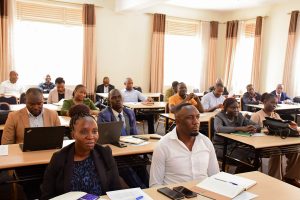
Dr Alfred Tingo from Makerere University’s Directorate of Graduate Training urged the new PhD students to understand university regulations, complete registration requirements and remain engaged throughout their studies. He called upon the students to maintain communication with their supervisors and university structures.
Dr Tingo highlighted the importance of the university’s Research Information Management System (RIMS) in monitoring students’ progress.
“RIMS helps us track your research progress. Your research topic, proposal development, approvals and supervisor interactions are captured in the system,” he said.
The new PhD programmes are expected to strengthen Makerere University’s contribution to research, innovation and policy development by producing scholars capable of generating knowledge for Uganda, Africa and the global community.