By Julius Tukacungura Guest Writer
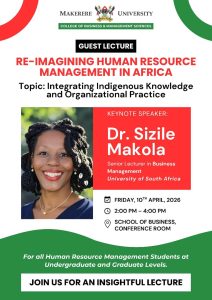
On Friday 10th April 2026, the School of Business under the College of Business and Management Sciences (CoBAMS) at Makerere University hosted a guest lecture titled: Re-Imagining Human Resource Management in Africa.
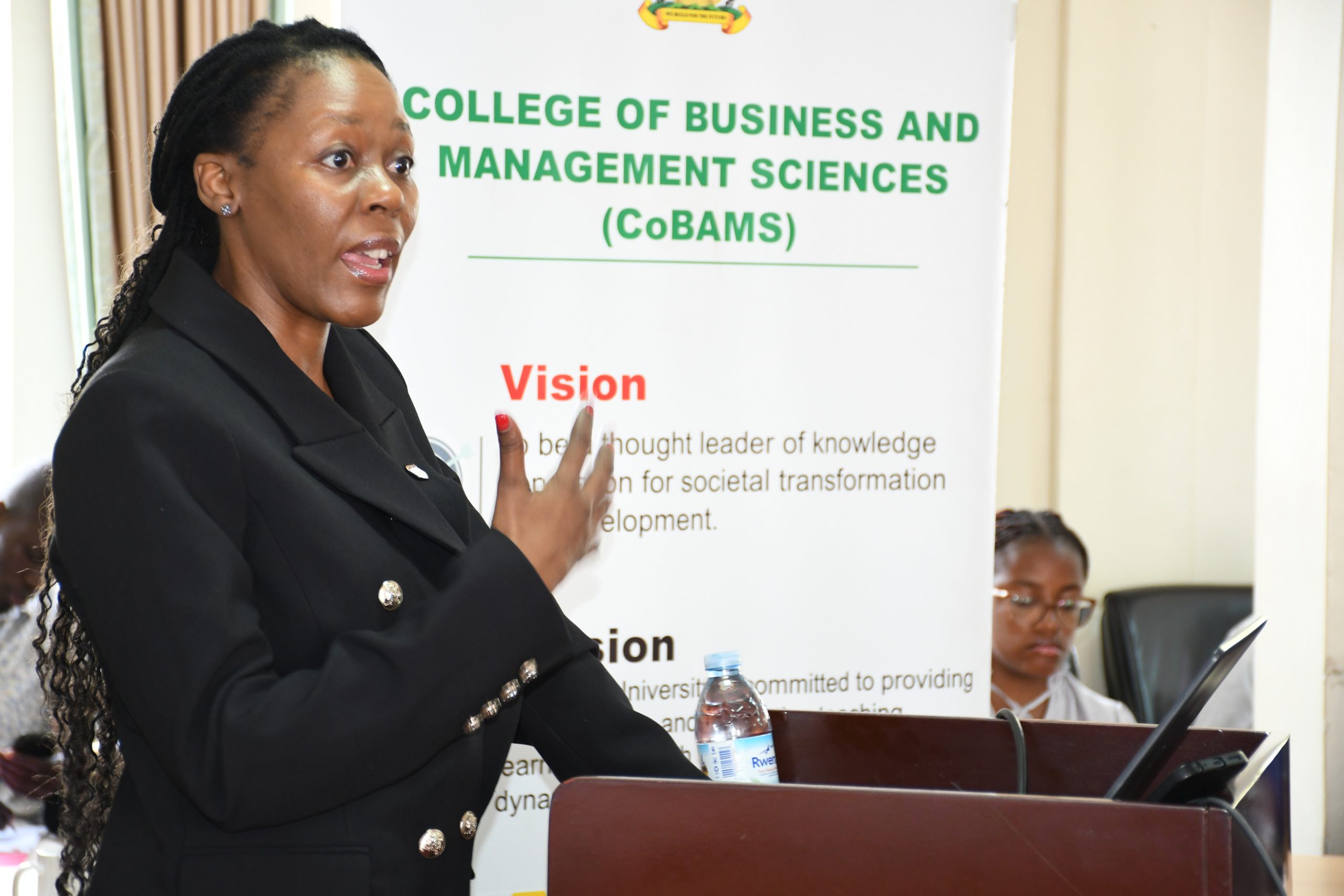
Delivering the lecture to undergraduate and graduate students pursuing human resource management courses at Makerere University, Dr. Sizile Makola, a researcher and Senior Lecturer in Business Management at the University of South Africa, focused on integrating indigenous knowledge and organizational practice.
Dr. Sizile Makola observed the need for African-centered human resource management thinking, rather than just adding local case studies to Western frameworks. Dr. Makola’s argument was informed by limitations of western human resource management frameworks, which assume autonomous individuals, formal institutions, and technical organizations, which are separate from family and community.
Dr. Makola explained that Africa is a diverse continent with multiple philosophical traditions, linguistic systems, and institutional histories, posing challenges in developing African-centered human resource management, including the risk of cultural generalization and erasing internal diversity, as well as, the mobilization of cultural language to protect power rather than challenge it.
She pointed out some of the examples of indigenous knowledge systems including: Ubuntu Bulamu-a humanness that produces well-being through relationships and interaction with others, Ekitiibwa-dignity, honour, and social standing that is relational and communal, and indigenous apprenticeship, knowledge transmission through relations built over time, observation, and participation.
She said: “These systems have implications for human resource management, including authority earned through demonstrated commitment to the well-being of others, knowledge transmitted through relationships and context, and workplace respect, grievance handling, and disciplinary processes prioritizing relational legitimacy and communal obligations,”
She pointed out that in Uganda, the National Human Resource Development Plan presents a road map for building human resources for the country’s development agenda, and the ministry’s communication strategy recognizes the developmental role of values, norms, identity, and positive mindsets.
Dr. Makola argued that researchers’ should theorize from African contexts, treat indigenous knowledge as a source of theory, use methodologies capturing moral, communal, and context-bound dimensions of work, and build concepts from African languages, values, and institutional histories.
Unique approaches to productivity and human resource management
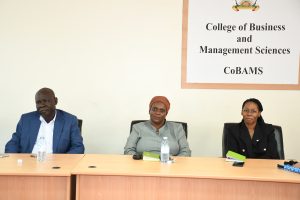
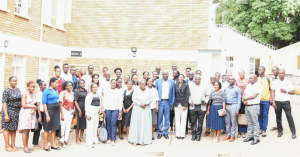
Addressing the participants assembled in the CoBAMS Conference Hall, Associate Professor Godfrey Akileng, the Dean of the School of Business at Makerere University, supported the narrative on, integrating indigenous knowledge into organizational practice.
He challenged the participants to think about translating indigenous knowledge into scholarship in business schools in Africa.
Aware of the Africa’s rich indigenous knowledge, passed down through generations, the Dean of the School of Business, questioned why Africa continues to lag behind in adopting Artificial Intelligence (AI) and other advancements.
Associate Professor Akileng noted cultural differences in management practices, illustrating how African contexts require unique approaches to productivity and human resources. He cited an example that necessitates the need for context-sensitive management.
“In Europe, when an officer comes to you and says, I have lost my mother, he or she will weep for ten minutes and go back to his or her desk and work. In Africa, when an officer comes to you to tell you that he or she has lost a mother, you know that they will spend a week mourning,” he stated.
Incorporating indigenous knowledge into the curriculum
Representing the Dr. Jude Mugarura, the Head of the Department of Marketing and Management, Dr. Zaina Nakabuye, expressed the readiness of the unit to incorporate indigenous knowledge into the curriculum. Dr. Nakabuye indicated that the teaching staff will ensure that topics for Masters and PhD students have a component on indigenous knowledge.
Dr. Nakabuye credited Dr. Sizile Makola for her great research works that advocate for the Africanization of human resource theories. She acknowledged Dr. Makola’s recognition of Obuntu in African contexts. “Dr. Makola has stated that Ubuntu-bulamu, just like we have it in luganda, Olusoga and other Bantu languages, is basically what is missing in our human resource theories,” said Dr. Nakabuye.
Integrating indigenous knowledge and Organizational practice
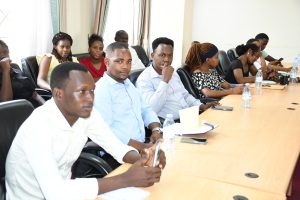
The discussion to integrate indigenous knowledge and organizational practice sparked debate, leading to the following highlights:
- Africa is not a country. It is a continent with so many diverse cultures, which requires to rethink the Ubuntu approach for the different groups. There is a gap between the ideal Ubuntu and its practical application in the human resource environments.
- The discussion raised questions about whose Ubuntu and indigenous knowledge would be prioritized. “Out of all of these different cultural communities, whose Ubuntu, is going to be seen and valued more than the other?”
- Africa’s diverse cultures dictate the need for context-specific management approaches. We cannot have a one-size-fits-all African-centered human resource management system.
- The AI models are developed using European and Western frameworks. This has led to ongoing debates on the ethical and moral issues on the usage of AI.
- Colonialism led to the devaluation of African systems, with Africans being taught that the Western way of doing things is the right way, and is the only way. Some of the participants, lamented the loss of African cultural identity and the tendency to assimilate into Western norms.
Way Forward
- The participants cited the need for African scholars to develop context-specific AI models that understand African languages and ways of life. “African scholars are now having a much larger voice to say, how do we develop African AI models that understand our context in terms of our way of life, our languages.”
- Participants concurred on the need for Africans to reclaim their identity and re-learn their own ways of knowing. “We need to reteach ourselves, we need to rethink, we need to unlearn and relearn who we are.”
- Africans were called upon to study factors responsible for the rise of the Eastern systems, and decline of the Western dominance in the East, which they attributed to the East’s strong cultural identity and commitment to their traditions. “The Asians, the Indians, the Chinese, the Japanese understand who they are, value their way of life and thinking.”
- The participants agreed on the importance of critiquing and refining African-centered models, saying, “The African-centered human resource model itself should be open to critique.”
Vote of thanks
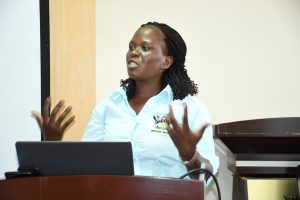
Ms. Agnes Sansa, a PhD student under the Department of Marketing and Management, commended Dr. Sizile Makola for a powerful presentation, which challenged both students and staff to re-imagine human resource management in Africa.
She acknowledged the online audience, which included Mr. Makola Kolodi (the father of Dr. Sizile Makola), as well as, staff and students, from the different units within Makerere University.
Photos about the Guest Lecture: