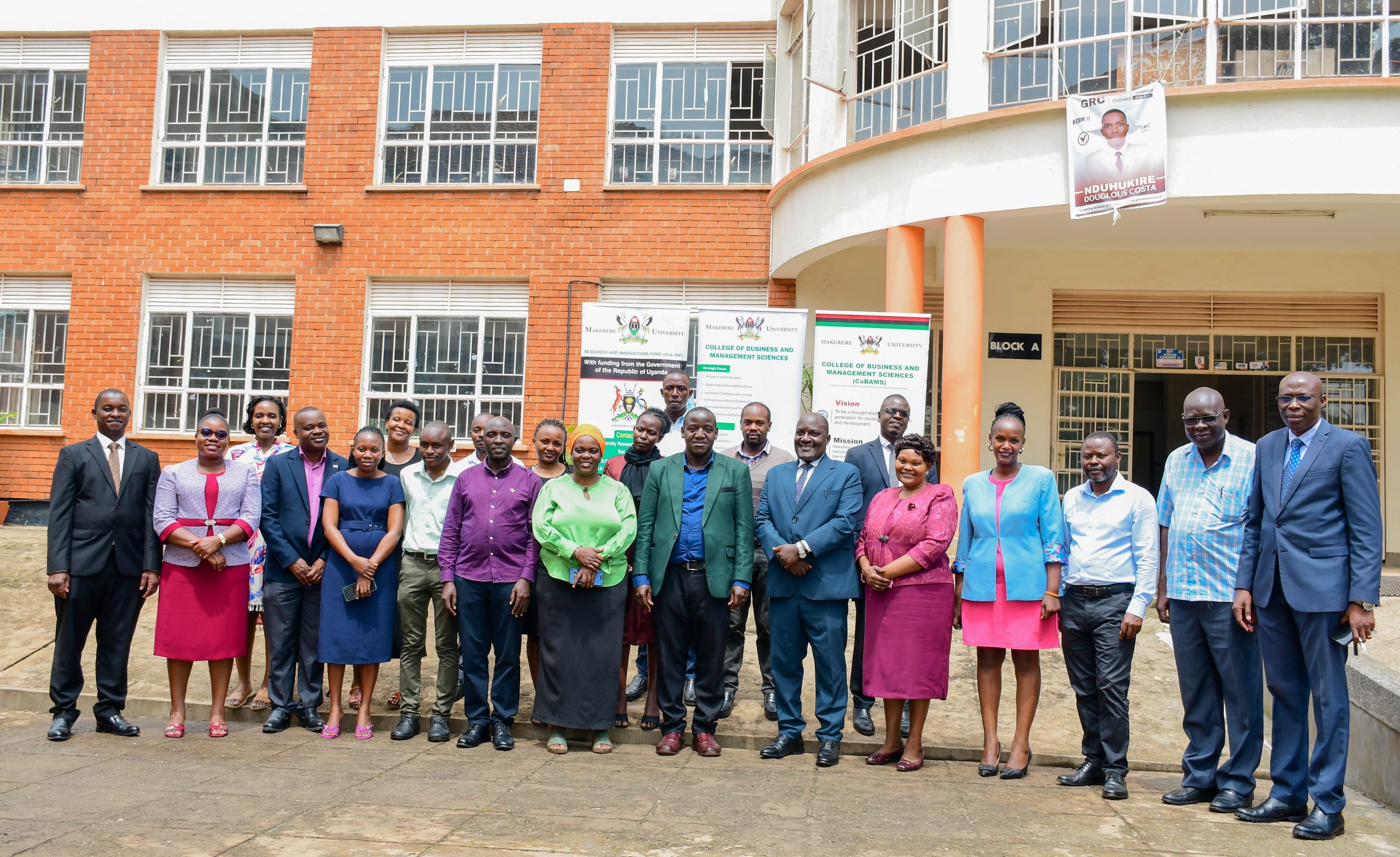
On Wednesday, 15th April 2026, the School of Business under the College of Business and Management Sciences (CoBAMS) at Makerere University hosted a project dissemination workshop that brought together researchers, practitioners, policymakers and faculty members.
The workshop focused on the presentation of findings and policy recommendations from the research project titled: Promoting Eco-Efficiency (EE) and Cleaner Production (CP) for sustainable development of Micro, Small and Medium Enterprises (MSMEs) in Uganda.
Opening the workshop, Associate Professor Godfrey Akileng, the Dean, School of Business represented by Dr. Anthony Tibaingana, the Head, Department of Marketing and Management welcomed participants and highlighted the role of research in connecting Makerere University to the wider community.
He noted that MSMEs form the backbone of Uganda’s economy making up the largest share of businesses across sectors and because of this, any meaningful research must speak directly to their realities.
The Dean of the School of Business commended the project team namely Dr. Marion Nanyanzi, Dr. Kasim Sendawula, and Associate Professor Peter K. Turyakira, for positively contributing to the university’s goal of being a research-led institution.
He explained that Eco-Efficiency (EE) is about using available resources wisely not just for today, but for tomorrow and generations to come. “In a country where most businesses operate on a small scale, understanding how to produce more with less is essential,” he said.
Dr. Tibaingana acknowledged the government of Uganda through the Makerere University Research and Innovation Fund (MakRIF) for funding the research project titled, Promoting Eco-Efficiency (EE) and Cleaner Production (CP) for sustainable development of Micro, Small and Medium Enterprises (MSMEs) in Uganda. He recognized Professor Fred Masagazi Masaazi, Chairperson of the Mak RIF Grants Management Committee (GMC) and thanked him, for gracing the dissemination workshop with his personal presence.
Achieving sustainable growth through eco-efficiency and cleaner production
The main presentation led by Dr. Marion Nanyanzi, the Principal Investigator (P.I.) unpacked the research project in a detailed and practical way. At its core, the study explored how MSMEs, particularly in the Food and Beverage (F&B) Service sector in Uganda can achieve sustainable growth by balancing three key areas: economic performance, environmental responsibility and social contribution.
From a social perspective, Dr. Nanyanzi stated that businesses were found to be playing an important role in creating jobs, supporting local suppliers, and contributing to community activities. She added that the study was also focused on reducing environmental harmful practices such as reliance on charcoal and firewood and adopting cleaner energy sources that would economically yield increased profits for enterprises.
The study revealed that while these enterprises significantly contribute to employment and government revenue, they face serious constraints pointing out that high operational costs especially electricity remain a major challenge. “ So, many businesses are forced to turn to cheaper alternatives that are harmful to both health and environment creating a difficult balance between survival and sustainability,” she said.
Amidst these challenges, the study highlighted the resilience and creativity of entrepreneurs. It was found out that many business owners have developed coping strategies to remain operational with some of them adjusting production depending on customer flow especially in areas such as Kampala where demand fluctuates with academic calendars. Dr. Nanyanzi noted that other entrepreneurs have found ways to manage resources more carefully for instance through switching on refrigerators at night when electricity tariffs are lower or re-using water to reduce costs.
Makerere University Guest House highlights its cleaner production strategy
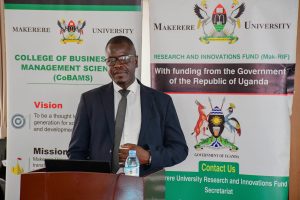
Adding a practical perspective to the study, Mr. Patrick Ojiambo Lwande, the manager of Makerere University Guest House shared how cleaner production is being implemented by the facility in its everyday operations. He mentioned that the facility undertakes waste segregation, recycling and proper waste management as key practices. “Organic waste is separated and repurposed, recyclable materials are re-used and hazardous waste is carefully handled to avoid environmental pollution,” he stated.
Appreciation of eco-efficiency and cleaner production measures
These practices reflect an emerging understanding of eco-efficiency by business owners who are beginning to recognize that reducing waste and conserving resources can directly improve their production line.
The study also found out that many enterprises are making efforts towards cleaner production. Hygiene standards are being improved, waste is better managed and emissions are controlled through simple measures such as chimneys and ventilation system. In some cases, food waste is used as animal feed while other organic materials are re-used in farming. However, the progress to transition towards more sustainable practices is slowed down by various obstacles including limited financial capacity, lack of technical skills and low awareness among business owners.
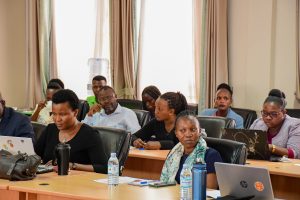
Key recommendations
To address these gaps, the project team proposed the following practical recommendations:
- Increasing access to affordable financing by government and financial institutions through introducing subsidies, grants, or low-interest green financing schemes to support investment in cleaner production technologies,
- Promoting public-private partnerships to lower the cost of eco-efficient equipment and infrastructure,
- Undertaking capacity building and training programmes, awareness and sensitization campaigns,
- Strengthening institutional and regulatory frameworks, research and innovation support,
- Providing support for small and informal businesses by designing tailored interventions for micro and small enterprises, and
- Encouraging business clustering and cooperative models to enable shared access to eco-efficient technologies and resources.
MakRIF supports research that addresses national priorities
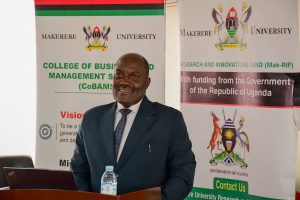
Professor Fred Masagazi Masaazi, Chairperson of Mak-RIF Grants Management Committee (GMC) emphasized the importance of research that addresses national priorities, noting that government support for research is meant to generate practical solutions.
Professor Masagazi Masaazi highlighted the critical role of micro, small, and medium enterprises (MSMEs) in Uganda’s economy, describing the research presented as both timely and relevant. “This is exactly the kind of research Uganda needs — research that directly impacts society and supports economic transformation,” he said.
He encouraged researchers to explore collaborations across disciplines. “Bringing together expertise from different fields can lead to stronger and more impact-oriented solutions that respond to the country’s development needs,” he added. He also called for greater engagement with policymakers and industry players during dissemination.
Research and Industry pathways
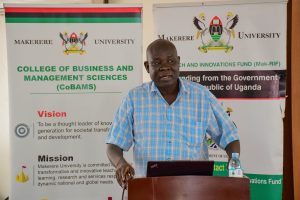
The Dean, School of Business, Associate Professor Godfrey Akileng urged researchers, faculty and participants at the dissemination workshop to rethink how research translates into real economic value, emphasizing stronger research to industry pathways at Makerere University and beyond.
Promoting environmental compliance
Mr. Peter Ssekajja, Senior Environmental Officer (Cleaner Production), National Environment Management Authority (NEMA) informed participants about the ongoing efforts to promote environmental compliance, referencing the establishment of a Compliance Assistance Unit and the introduction of the National Environment Sustainability Awards as some of the supporting measures.
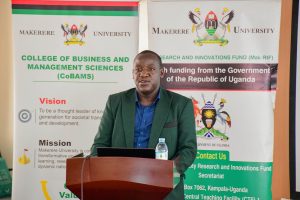
He stated that these initiatives aim to support businesses in adopting sustainable practices while recognizing those that are leading the way. “Environment is no longer just about enforcement, but also about guidance, innovation and collaboration,” he emphasized.
Mr. Ssekajja reflected on the changing nature of environmental challenges as populations grow and resources becoming more strained. He appealed for efficient and responsible use of resources by business owners. He implored the business owners to consider sustainability not as a burden, but as an opportunity.
Participants enlightened on eco-efficiency and cleaner production
Dr. Jude Mugarura, the Head, Department of Marketing and Management, appreciated the dissemination workshop which presented them with an opportunity to listen to both the research project team and two practitioners namely Makerere University Guest House, and the National Management Environment Authority (NEMA). “We are therefore able to bridge the academia and the field of practice,” said Dr. Mugarura.
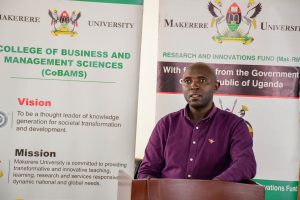
Dr. Seperia Bwadene Wanyama, from the School of Business, thanked Mr. Peter Ssekajja from NEMA for his presentation on cleaner production and eco-efficiency, which demonstrated to the participants some of the day-to-day wasteful practices with respect to resources, that they were engaged in, without knowing the implications. A key highlight focused on the usage of water in toilets which indicates the button to press after a short call, and the one to press after a long call, which would greatly save water consumption. “Learning is a continuous process. I have learned from the presentations of the findings by the research project team, as well as, Mr. Peter Ssekajja, who provided an informative presentation on real life practices on eco-efficiency and cleaner production.”
Conclusion: Toward a Clean and Resilient Economy
The workshop concluded with a strong call for collective action to support MSMEs in
adopting eco-efficient practices. With the right support, small businesses can become engines of sustainable development. “This study provides practical insights that, if implemented, can transform MSMEs into drivers of sustainable development,” Dr. Sendawula emphasized.
Overall, the research outlines a clear pathway toward a greener, more resilient Ugandan economy—where MSMEs thrive while contributing to environmental sustainability and social well-being.
Christopher Kaahwa contributed to this story as a Guest Writer