
Makerere University has launched a knowledge-sharing platform designed to bridge research, education, and community outreach, with the aim of accelerating innovation and economic development in Uganda.
The platform is the outcome of a project led by Prof. Edward Bbaale, which examined how universities can translate research, innovations, and institutional capabilities into tangible impact for communities, businesses, and national economic growth, in line with the government’s tenfold growth agenda. The project was funded by the Government of Uganda through the Makerere University Research and Innovations Fund (Mak-RIF).
The study also explored how university-based research and innovation can be better aligned with Uganda’s development priorities in agriculture, tourism, mineral-based industrialization, and science and technology, as outlined in the Fourth National Development Plan (NDP IV).
Speaking at the launch, the First Deputy Vice-Chancellor for Academic Affairs, Prof. Sarah Ssali, said the platform would strengthen the link between academic research and societal transformation. She also noted that knowledge production and utilization is a political matter and urged researchers to meaningfully engage and participate in such converstaions.
Dr. Stephen Wandera, representing the Chairperson of the Mak-RIF Grants Management Committee, described the platform as timely and relevant, noting that it comes at a period when Makerere University is positioning itself as a research-led institution with measurable impact on communities and systems.
“The knowledge-sharing platform will enable researchers to disseminate their work to relevant audiences,” Dr. Wandera said. He added that dissemination workshops are among several avenues available for sharing research findings and urged the project team to explore additional channels, including policy briefs, academic publications, and online dialogue platforms.
The Director of Research, Innovation, and Partnerships, Prof. Robert Wamala, said the dissemination workshop reflects Makerere University’s long-standing commitment to generating knowledge that responds to national priorities, advances innovation, and contributes to Uganda’s socio-economic transformation.
He added that the Directorate supports initiatives that move research beyond academic boundaries into practical application, policy influence, enterprise development, and community impact.
Dr. Peter Babyenda, the project’s Co-Principal Investigator, said the initiative combined research, outreach, and capacity-building activities, drawing lessons from global models where universities play a direct role in community development by supporting agriculture, industry, and the growth of Small and Medium Enterprises (SMEs) and Micro, Small, and Medium Enterprises (MSMEs).
Dean of the School of Economics, Prof. Ibrahim Michael Okumu, observed that while Uganda’s universities have produced substantial research, its translation into practical outcomes has remained slow. He cautioned that Makerere University’s relevance will ultimately be measured by the extent to which its work contributes to national development.
Dr. Babyenda noted that the platform will support the development of sustainable research, education, and outreach systems, helping to bridge the gap between university research and real-world application.
“As we launch this platform, I encourage academics, students, industry players, policymakers, and communities to actively engage with it,” Prof. Wamala said. “Let it serve as a living space for dialogue, learning, co-creation, and innovation.”
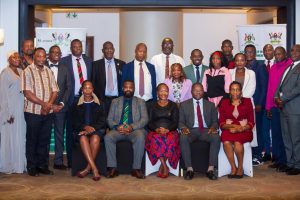
The knowledge-sharing platform is accessible to the public at www.dissemination.ug. Its launch took place at Sheraton Hotel in Kampala and was attended by officials from Makerere University, Kyambogo University, Gulu University, Mbarara University of Science and Technology (MUST), Busitema University, and Soroti University.