

- This event has passed.
INVITATION:
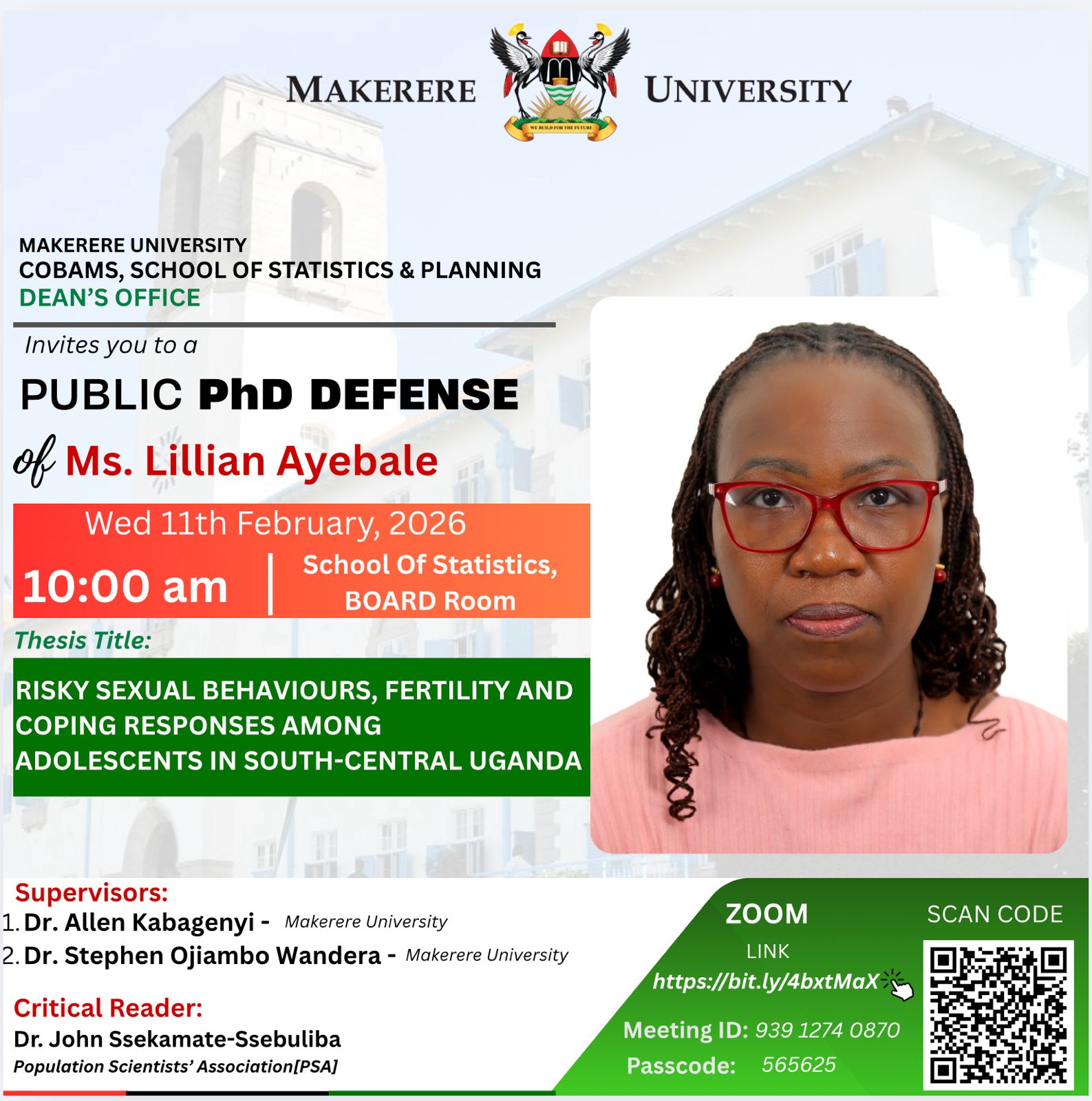
The Dean, School of Statistic and Population Studies under the College of Business and Management Sciences (CoBAMS), cordially invites you to the PhD Public Defense of the following candidate:
Name of the Candidate: Ms. Lillian Ayebale
Title of Thesis:
Risky Sexual Behaviours, fertility and coping responses among adolescents in South- central Uganda
Date: Wednesday 11th Februrary 2026.
Time: 10:00am – 1:00pm
Venue:
School of Statistics Board Room
ABSTRACT
Adolescents in Uganda face multiple vulnerabilities and exposures to risks. Approximately 25% of Ugandan teenagers become pregnant by the age of 19 years. This study explored and examined risky sexual behaviors, fertility, and coping responses among adolescents in South-Central Uganda.
This was a mixed-methods study. It involved a systematic review of studies on correlates of fertility among adolescents in SSA, statistical analysis of risky sexual behaviors among adolescents, and qualitative interviews with adolescents and parents from the Rakai Community Cohort Study (RCCS), a population-based HIV surveillance cohort. A systematic review protocol was developed and published in PROSPERO to guide the systematic synthesis of determinants of adolescent fertility in SSA. A negative binomial regression model was used to determine the risky sexual behaviours among adolescents, while the qualitative data analysis adopted an interpretivist approach to understand risky sexual behaviors and how parents influence these adolescent behaviors.
Cultural practices and taboos, child marriages, lack of parent-child communication on sexual matters, socioeconomic factors, and adolescent individual factors were consistently cited as key correlates of adolescent fertility according to the systematic synthesis. Adolescents aged 18-19 exhibited a significantly higher incidence of risky sexual behaviours compared to those aged 15-17 (aIRR = 2.01, 95% CI: 1.77-2.28). Living in a single-mother family structure (aIRR = 1.36, 95% CI: 1.15-1.60), with other relatives (aIRR = 1.34, 95% CI: 1.12-1.60), with non-relatives (aIRR = 1.53, 95% CI: 1.21-1.94), or alone (adolescent-headed) (aIRR = 1.68, 95% CI: 1.34-2.10) were all associated with higher incidence rates compared to living with both biological parents. Parents acknowledged that talking with adolescents could help reduce risky sexual behaviour. Parental talks on sexual matters were usually unplanned and happened when triggered by specific incidents.
Evidence from the results suggest that adolescents engage in risky sexual behaviours including non-marital sexual partnerships, multiple sexual partners, unprotected sex with a non-marital partner, and transactional sex. Parent-adolescent communication on sexual matters is essential/pertinent approach is needed to reduce/avert the associated risks. There is need for continuous engagement of all different stakeholders involved in adolescents work to have targeted interventions to prevent the risky sexual behaviours among the young people.
Supervisors:
- Allen Kabagenyi
- Stephen Ojiambo Wandera
Critical Reader:
Dr. John Ssekamate – Ssebuliba
Your presence and participation will be highly appreciated as we support the student in this important academic milestone.