

- This event has passed.
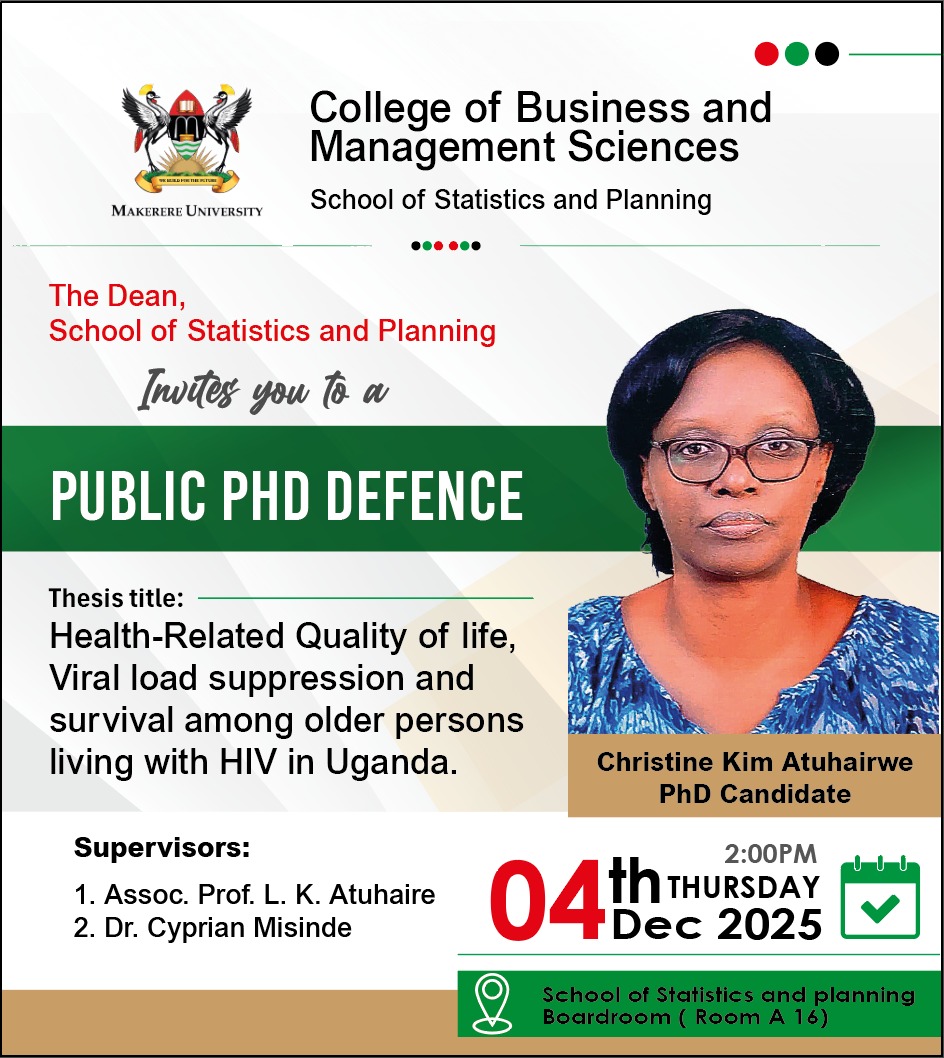
INVITATION:
The Dean, School of Statistics and Planning under the College of Business and Management Sciences (CoBAMS), cordially invites you to the PhD Public Defense of the following candidate:
Name of the Candidate: Christine Kim Atuhairwe
Title of Thesis:
HEALTH-RELATED QUALITY OF LIFE, VIRAL LOAD SUPPRESSION AND SURVIVAL AMONG OLDER PERSONS LIVING WITH HIV IN UGANDA
Date: Wednesday 4th December 2025.
Time: 2:00pm-5:00pm
Venue: CoBAMS Conference Hall at Makerere University
Abstract
Older persons living with HIV (aged ≥50 years) have increased, a noteworthy public health challenge in low-and middle-income countries. Access to Antiretroviral Therapy (ART) innovations are improving health-related quality of life, viral suppression and survival of persons living with HIV enrolled and retained on ART. The study aimed to determine Health-Related Quality of Life, viral suppression and survival of older persons living with HIV in Uganda.
A cross-sectional survey was carried out to determine the HR-QoL and viral suppression using a semi structured questionnaire. Overall, 439 older persons living with HIV were interviewed about their socio-demographic characteristics, lifestyle, clinical and no-clinical factors and analyzed using the binary logistic regression model. OPLHIV quality of life was studied using the domains of general health perception, physical functioning, role functioning, social functioning, energy/fatigue, health distress and mental health and analyzed using the ordinal regression model. Also, a retrospective longitudinal study analysis of electronic medical records of OPLHIV from TASO centres of excellence was done using the Cox Hazard Regression Model.
The mean age of the participants was 58.0 years (±SD 7.4 years). About 42% of OPLHIV had a good HRQoL. General health perception was associated with multiple sexual partners (p=0.038), advanced HIV disease (p=0.011), and a viral load >200 copies/ml (p=0.003). Physical functioning correlated with tertiary education (p=0.049), being separated (p=0.004), 11-15 years on ART (p=0.027), and WHO clinical stage II (p=0.050). Factors for role functioning included age 60+ (p=0.002), secondary education (p=0.021), unemployment (p=0.001), WHO clinical stage II (p=0.002), and TB history (p=0.037). Social functioning linked to secondary education (p=0.004), being widowed (p<0.001), viral load >200 copies/ml (p=0.008), and WHO clinical stage II (p=0.011). Pain was associated with age 60+ (p=0.014), tertiary education (p=0.004), and unemployment (p=0.005). Energy correlated with secondary education (p=0.062), being separated (p=0.021), viral load >200 copies/ml (p=0.003), and WHO clinical stage II (p=0.028). Health distress was tied to secondary education (p<0.001), tertiary education (p<0.001), unemployment (p=0.033), and WHO stage II (p<0.001). Finally,
mental health was associated with secondary education (p=0.017), being widowed (p=0.043), multiple sexual partners (p=0.015), and WHO stage II (p=0.001). Overall HRQoL specifically correlated with age 60+ (p<0.001), secondary education (p<0.001), and WHO stage II (p=0.008).
About 88% had a viral load of less than 200 copies/µL. The factors associated with viral load less than 200 copies/µL were: being unemployed (aOR=4.1; 95% CI 1.73-9.84), WHO stage II (aOR 0.14; 95% CI 0.04-0.53), good adherence (aOR=16.6; 95% CI 1.91-145.60), having
no recent history of opportunistic infections (aOR=0.28; 95% CI 0.07-1.09), receiving spousal/family support (aOR=2.6; 95% CI 0.98-7.19), and receiving food supplies (aOR=6.0; 95% CI 1.17-31.58). No significant difference could be established with other variables.
A total of 30,758 medical records of OPLHIV from 1987-2023 were identified from TASO medical records. Of these 73% were active on ART, 6% had dead, 15% lost to follow up and 6% had transferred to other health facilities or regions. The survival of OPLHIV was significantly associated with being female (aHR=1.19; 95% CI 1.15-1.22), being married (aHR=0.99; 95% CI 0.77-0.80), separated/divorced persons (aHR=0.85; 95% CI 0.80-0.90), WHO clinical stage II (aHR=1.66; 95% CI 1.62-1.73), viral load >200 copies/µL (aHR=1.49; 95% CI 1.44-0.154) and fair adherence (aHR=0.94; 95% CI 0.74-1.19).
To improve the health-related quality of life, viral suppression and survival of OPLHIV; there is need to increase routine clinical screening of WHO clinical stage, viral load, CD4 count, blood plasma viremia, disease status, tuberculosis and adherence to improve health care providers’ treatment practices.
Supervisors:
- Associate Professor L. K Atuhaire
- Cyprian Misinde
Your presence and participation will be highly appreciated as we support the student in this important academic milestone.